
Six Math Essentials
• Just a brief announcement that I have been working with Quanta Books to publish a short book in popular mathematics entitled ‘Six Math Essentials’, which will cover six of the fu
• Just a brief announcement that I have been working with Quanta Books to publish a short book in popular mathematics entitled ‘Six Math Essentials’, which will cover six of the fu
• The Univalence Principle Posted by Mike Shulman (guest post by Dimitris Tsementzis, about joint work with Benedikt Ahrens, Paige North, and Mike Shulman) The Univalence Principle

• Updates on my research and expository papers, discussion of open problems, and other maths-related topics. • By Terence Tao Home About Career advice On writing Books Mastodon+ Ap
• John Baez extends his categorification of the Riemann zeta function to its functional equation. • The completed zeta ξ(s) includes a real prime factor, key to symmetry. • Categor

• Thomas Bloom’s Erdös problem site now thrives with AI‑assisted solutions. • Human, AI, and hybrid contributions are discussed and approved as updates. • A curated problem databas
• Rogers theorem addresses density of integers remaining after removing finite congruence classes in sieve theory. • The theorem appears only in Halberstam & Roth’s 1966 text, unpu

• Like many other areas of modern analysis, analytic number theory often relies on the convenient device of asymptotic notation to express its results. • It is common to use notati

• Updates on my research and expository papers, discussion of open problems, and other maths-related topics. • By Terence Tao Home About Career advice On writing Books Mastodon+ Ap
• The n-Category Café Skip to the Main Content Note:These pages make extensive use of the latest XHTML and CSSStandards. • They ought to look great in any standards-compliant moder

• I’ve just uploaded to the arXiv my preprint The maximal length of the Erdős-Herzog-Piranian lemniscate in high degree. • This paper resolves (in the asymptotic regime of sufficie

• Matthew Bolan, Joachim Breitner, Jose Brox, Nicholas Carlini, Mario Carneiro, Floris van Doorn, Martin Dvorak, Andrés Goens, Aaron Hill, Harald Husum, Hernán Ibarra Mejia, Zoltan

• Problem 1026 on the Erdős problem web site recently got solved through an interesting combination of existing literature, online collaboration, and AI tools. • The purpose of thi
• Octonions and the Standard Model (Part 13) Posted by John Baez When Lee and Yang suggested that the laws of physics might not be invariant under spatial reflection - that there’s
• The n-Category Café Skip to the Main Content Note:These pages make extensive use of the latest XHTML and CSSStandards. • They ought to look great in any standards-compliant moder

• Updates on my research and expository papers, discussion of open problems, and other maths-related topics. • By Terence Tao Home About Career advice On writing Books Mastodon+ Ap
• Octonions and the Standard Model (Part 12) Posted by John Baez Having spent a lot of time pondering the octonionic projective plane and its possible role in the Standard Model of
• The n-Category Café Skip to the Main Content Note:These pages make extensive use of the latest XHTML and CSSStandards. • They ought to look great in any standards-compliant moder
• The n-Category Café Skip to the Main Content Note:These pages make extensive use of the latest XHTML and CSSStandards. • They ought to look great in any standards-compliant moder
• The n-Category Café Skip to the Main Content Note:These pages make extensive use of the latest XHTML and CSSStandards. • They ought to look great in any standards-compliant moder
• The n-Category Café Skip to the Main Content Note:These pages make extensive use of the latest XHTML and CSSStandards. • They ought to look great in any standards-compliant moder
• The n-Category Café Skip to the Main Content Note:These pages make extensive use of the latest XHTML and CSSStandards. • They ought to look great in any standards-compliant moder
• The n-Category Café Skip to the Main Content Note:These pages make extensive use of the latest XHTML and CSSStandards. • They ought to look great in any standards-compliant moder

• Good Reads: The Princeton Companion to Mathematics Next up onGood Reads: ThePrinceton Companion to Mathematics,edited by Fields medalistTimothy Gowers.This book is an exceptional

• What is a Good Quantum Encoding? • Part 1 Over the past couple of years, I’ve been learning a little about the world of quantum machine learning (QML) and the sorts of things peo
• The n-Category Café Skip to the Main Content Note:These pages make extensive use of the latest XHTML and CSSStandards. • They ought to look great in any standards-compliant moder
• The n-Category Café Skip to the Main Content Note:These pages make extensive use of the latest XHTML and CSSStandards. • They ought to look great in any standards-compliant moder
• Burrito Monads, Arrow Kitchens, and Freyd Category Recipes Posted by Tom Leinster Guest post by Khyathi Komalan and Andrew Krenz From Lawvere’s Hegelian taco to Baez’s layer cake

• Math3ma celebrates 10‑year anniversary, reflecting on growth from niche blog to influential math resource. • Author began as study tool, now shares graduate‑level insights with g

• Launch of new video podcast ‘fAQ’ featuring casual chats on quantum physics and AI. • Co-hosts: author and Adam Green, a biologist and former Khan Academy academic director. • Ta

• Superposition is simply a linear combination of states, like adding vectors in linear algebra. • The concept can be visualized without math using everyday analogies, such as over
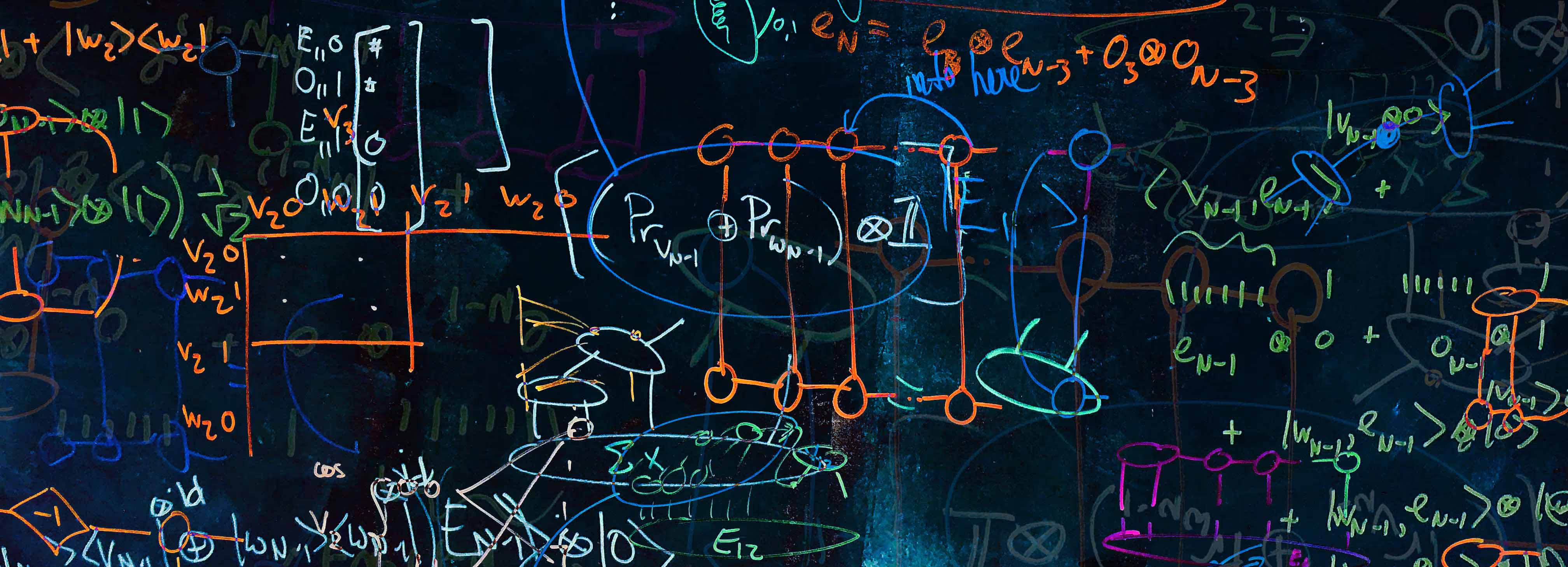
• Introduces quantum-inspired methods for modeling sequential data via tensor networks. • Uses bipartite graph representations of matrices to visualize linear maps. • Applies quant

• SVD decomposes any matrix M into UDV†, revealing singular values and vectors. • Singular values, arranged in D, indicate the importance of each concept in M. • Left and right sin

• SandboxAQ spun out of Alphabet, focusing on AI and quantum technologies. • Founder Jack Hidary explains what quantum technology means in new YouTube videos. • The team emphasizes

• Symposium at The Master’s University, Santa Clarita, California, June 9-10, 2024. • Math3ma Institute hosts event, inviting scholars, industry, and government scientists. • NASA
• Introduces a novel link between Shannon entropy and topological simplices via operad derivations. • Explores how entropy functions satisfy a Leibniz-like rule on simplicial struc

• Yoneda lemma states that an object is fully determined by its hom‑functor relationships. • Yoneda embedding maps each object X to functor hom(-,X), fully faithful. • Morphisms f:

• Math3ma expands into a new research hub, the Math3ma Institute, on TMU campus and online. • Visiting professor at TMU collaborates with math, science, engineering faculty to laun

• Grant Sanderson shares early inspirations that sparked his passion for math and physics. • He reflects on his graduate school journey and key learning moments. • The conversation
• Introduces enriched category theory framework for modeling language expressions and their relationships. • Builds on Part 2’s set assignment to words, extending to statistical co
• The Monotone Convergence Theorem (MCT) allows interchange of limit and integral for increasing nonnegative functions. • MCT requires pointwise a.e. convergence, measurability, an
• DCT states limit and integral commute under pointwise a.e. convergence with integrable dominating function. • Requires measurable functions and existence of integrable g bounding
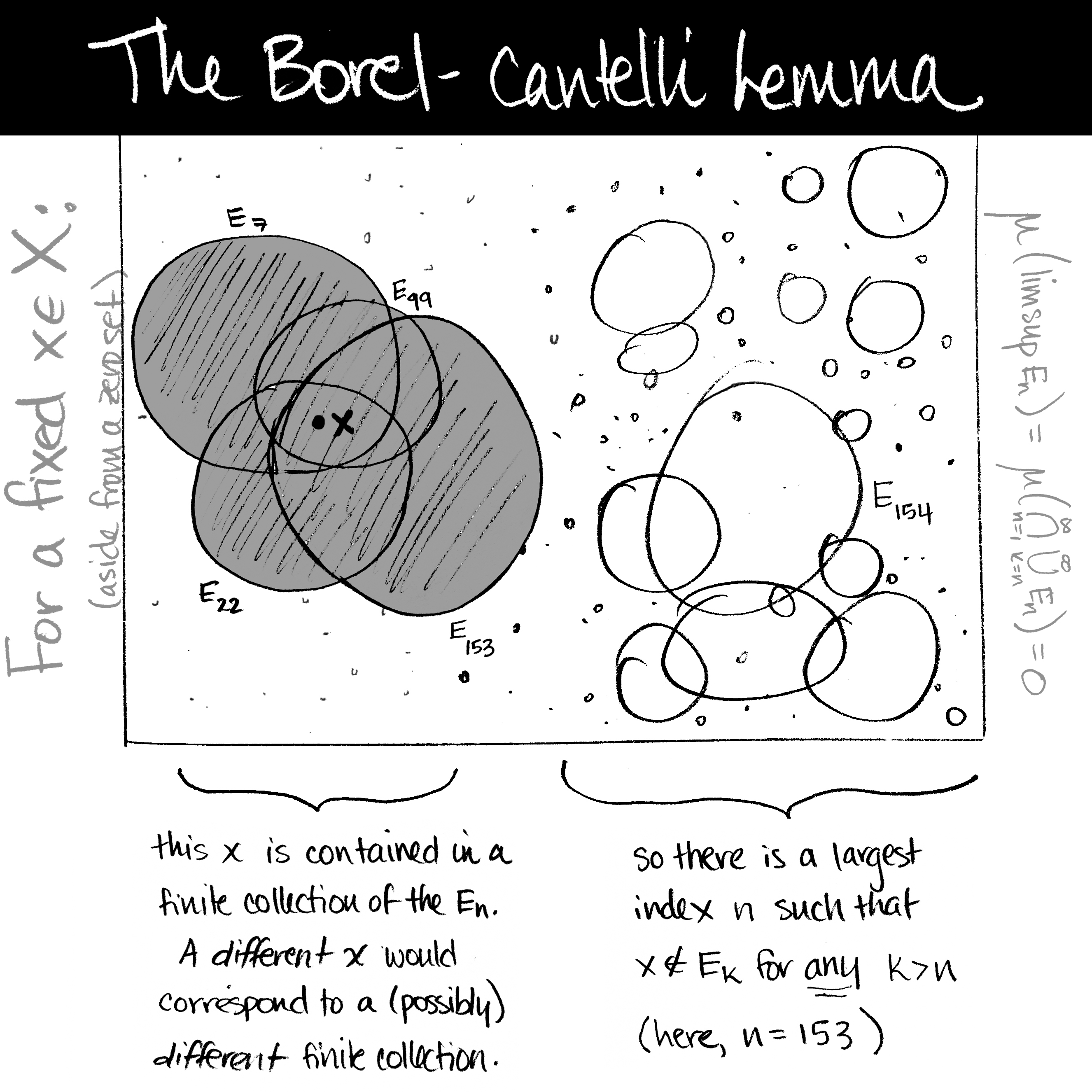
{ ‘summary’: [ ‘• The Borel‑Cantelli Lemma applies to any finite‑measure space, not just probability spaces.’, ‘• It states that if the sum of measures of sets (E_n) converges

• Introduces function d(x) = -x log x, a derivation reminiscent of Leibniz rule. • d relates to Shannon entropy, but is nonlinear, so H(p) ≠ d(∑ p_i). • Paper shows Shannon entropy

• Language modeled as category L: objects are English expressions, morphisms are substring inclusions. • Category L captures syntax but lacks semantic depth, prompting richer categ
• Authors propose a new preprint exploring math behind large language models. • Question: how to model transition from probability distributions on text to syntax and semantics. •