Conditional diffusion with locality-aware modal alignment for generating diverse protein conformational ensembles

Conditional diffusion with locality-aware modal alignment for generating diverse protein conformational ensembles

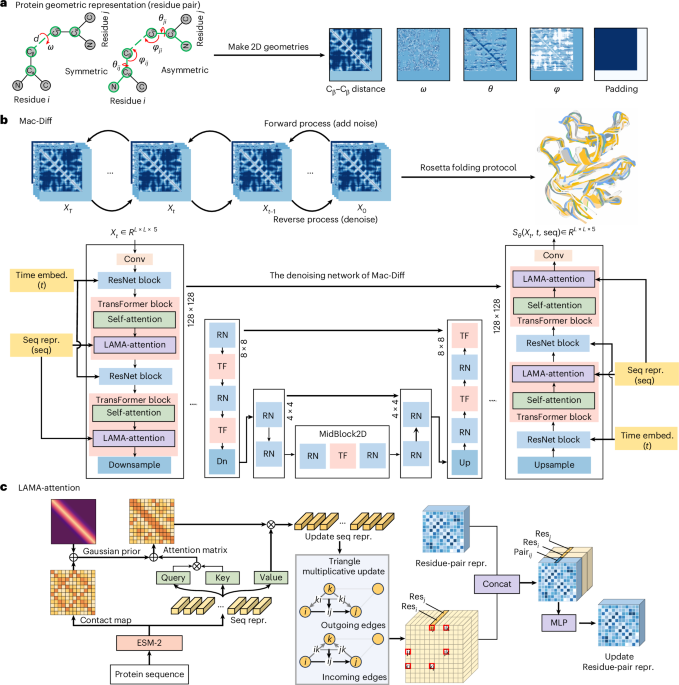
• Abstract Recent advances in artificial intelligence have enabled accurate prediction of a protein’s stable structure solely based on its amino acid sequence • However, capturing


Research & Labs · February 26, 2026 (updated February 26, 2026) · 2 min · 227 words

Author Correction: Mask-prior-guided denoising diffusion improves inverse protein folding

• Subjects Computer science Machine learning Protein design TheOriginal Articlewas published on 16 June 2025 Correction to:Nature Machine Intelligencehttps://doi.org/10.1038/s42256

Research & Labs · February 25, 2026 (updated February 25, 2026) · 2 min · 351 words
Diffusion Modulation via Environment Mechanism Modeling for Planning

Diffusion Modulation via Environment Mechanism Modeling for Planning

• Computer Science > Artificial Intelligence [Submitted on 23 Feb 2026] Title:Diffusion Modulation via Environment Mechanism Modeling for Planning View PDF HTML (experimental)Abstr

Research & Labs · February 25, 2026 (updated February 25, 2026) · 2 min · 235 words
When Backdoors Go Beyond Triggers: Semantic Drift in Diffusion Models Under Encoder Attacks

When Backdoors Go Beyond Triggers: Semantic Drift in Diffusion Models Under Encoder Attacks

• Computer Science > Cryptography and Security [Submitted on 21 Feb 2026] Title:When Backdoors Go Beyond Triggers: Semantic Drift in Diffusion Models Under Encoder Attacks View PDF

Research & Labs · February 25, 2026 (updated February 25, 2026) · 2 min · 245 words

Who is using AI to code? Global diffusion and impact of generative AI

• Science, Volume 391, Issue 6787, Page 831-835, February 2026. • Science, Volume 391, Issue 6787, Page 831-835, February 2026.

Science · February 24, 2026 (updated February 25, 2026) · 2 min · 230 words

Overcoming Dimensional Factorization Limits in Discrete Diffusion Models through Quantum Joint Distribution Learning

• Abstract Discrete diffusion models typically rely on dimension-wise factorization to avoid computational intractability. • However, we rigorously prove this approach leads to wor

Quantum Computing · February 24, 2026 (updated February 24, 2026) · 2 min · 241 words
Diffusing to Coordinate: Efficient Online Multi-Agent Diffusion Policies

Diffusing to Coordinate: Efficient Online Multi-Agent Diffusion Policies

• Computer Science > Artificial Intelligence [Submitted on 20 Feb 2026] Title:Diffusing to Coordinate: Efficient Online Multi-Agent Diffusion Policies View PDF HTML (experimental)A

Research & Labs · February 23, 2026 (updated February 24, 2026) · 1 min · 206 words

Language barriers slow down the international diffusion of knowledge, study finds

• Rapid technological and scientific advances have fueled a huge wave of innovation over the past decades. • The speed of global innovation is known to be dependent on the exchange

Science · February 22, 2026 (updated February 24, 2026) · 1 min · 139 words

Who is using AI to code? Global diffusion and impact of generative AI

• Science, Volume 391, Issue 6787, Page 831-835, February 2026.

Science · February 22, 2026 (updated February 23, 2026) · 1 min · 117 words

Overcoming Dimensional Factorization Limits in Discrete Diffusion Models through Quantum Joint Distribution Learning

• Abstract Discrete diffusion models typically rely on dimension-wise factorization to avoid computational intractability. • However, we rigorously prove this approach leads to wor

Quantum Computing · February 22, 2026 (updated February 23, 2026) · 2 min · 242 words

Enhanced Li-ion diffusion improves N2-to-NH3 current efficiency at 100 mA cm−2

• Science, Volume 391, Issue 6786, Page 724-729, February 2026.

Science · February 19, 2026 (updated February 24, 2026) · 1 min · 12 words
Generating text with diffusion (and ROI with LLMs)

Generating text with diffusion (and ROI with LLMs)

• In part 1, Ryan chats with the co-founder and CEO of Inception, Stefano Ermon, about diffusion language models and how their multiple token generation compares to traditional LLM

Developer Ecosystem · February 3, 2026 (updated February 24, 2026) · 2 min · 227 words
Repurposing Protein Folding Models for Generation with Latent Diffusion

Repurposing Protein Folding Models for Generation with Latent Diffusion

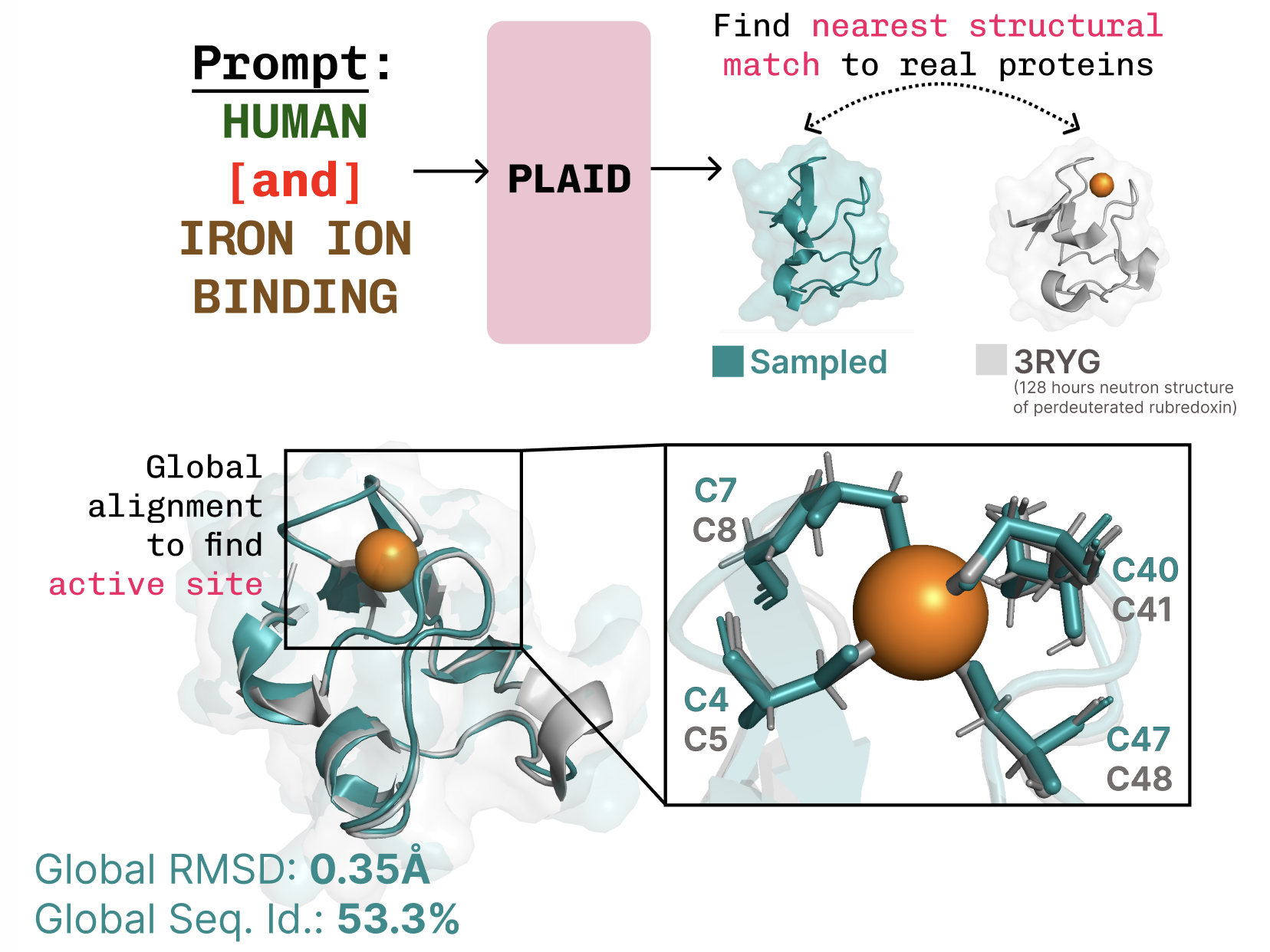
• PLAID is a multimodal generative model that simultaneously generates protein 1D sequence and 3D structure, by learning the latent space of protein folding models. • The awarding

Research · April 8, 2025 (updated February 19, 2026) · 2 min · 231 words