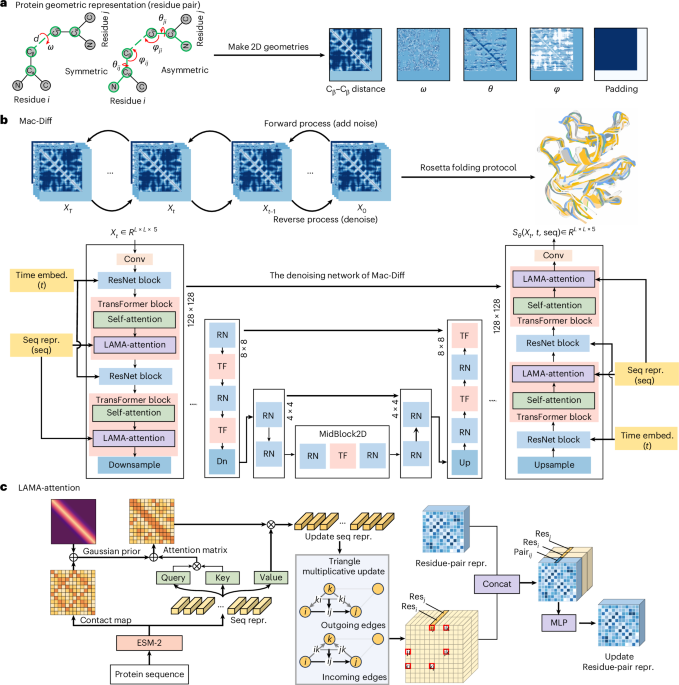
• Abstract Recent advances in artificial intelligence have enabled accurate prediction of a protein’s stable structure solely based on its amino acid sequence • However, capturing the complete conformational landscape of a protein and its dynamic flexibility remains challenging • Here we developed modal-aligned conditional diffusion (Mac-Diff), a score-based diffusion model for generating the conformational ensembles for unseen proteins • Central to Mac-Diff is an attention module that enforces a delicate, locality-aware alignment between the conditional view (protein sequence) and the target view (residue pair geometry) to compute highly contextualized features for effective structural denoising and generation • Furthermore, Mac-Diff leverages semantically rich sequence embedding from protein language models such as ESM-2 in enforcing the protein sequence condition that captures evolutionary, structural and functional information • Mac-Diff showed promising results in generating realistic and diverse protein structures
Article Summaries:
- Abstract Recent advances in artificial intelligence have enabled accurate prediction of a protein’s stable structure solely based on its amino acid sequence. However, capturing the complete conformational landscape of a protein and its dynamic flexibility remains challenging. Here we developed modal-aligned conditional diffusion (Mac-Diff), a score-based diffusion model for generating the conformational ensembles for unseen proteins. Central to Mac-Diff is an attention module that enforces a delicate, locality-aware alignment between the conditional view (protein sequence) and the target view
Sources:
- https://www.nature.com/articles/s42256-026-01198-9 (Latest source article published: 2026-02-26 07:31 UTC)