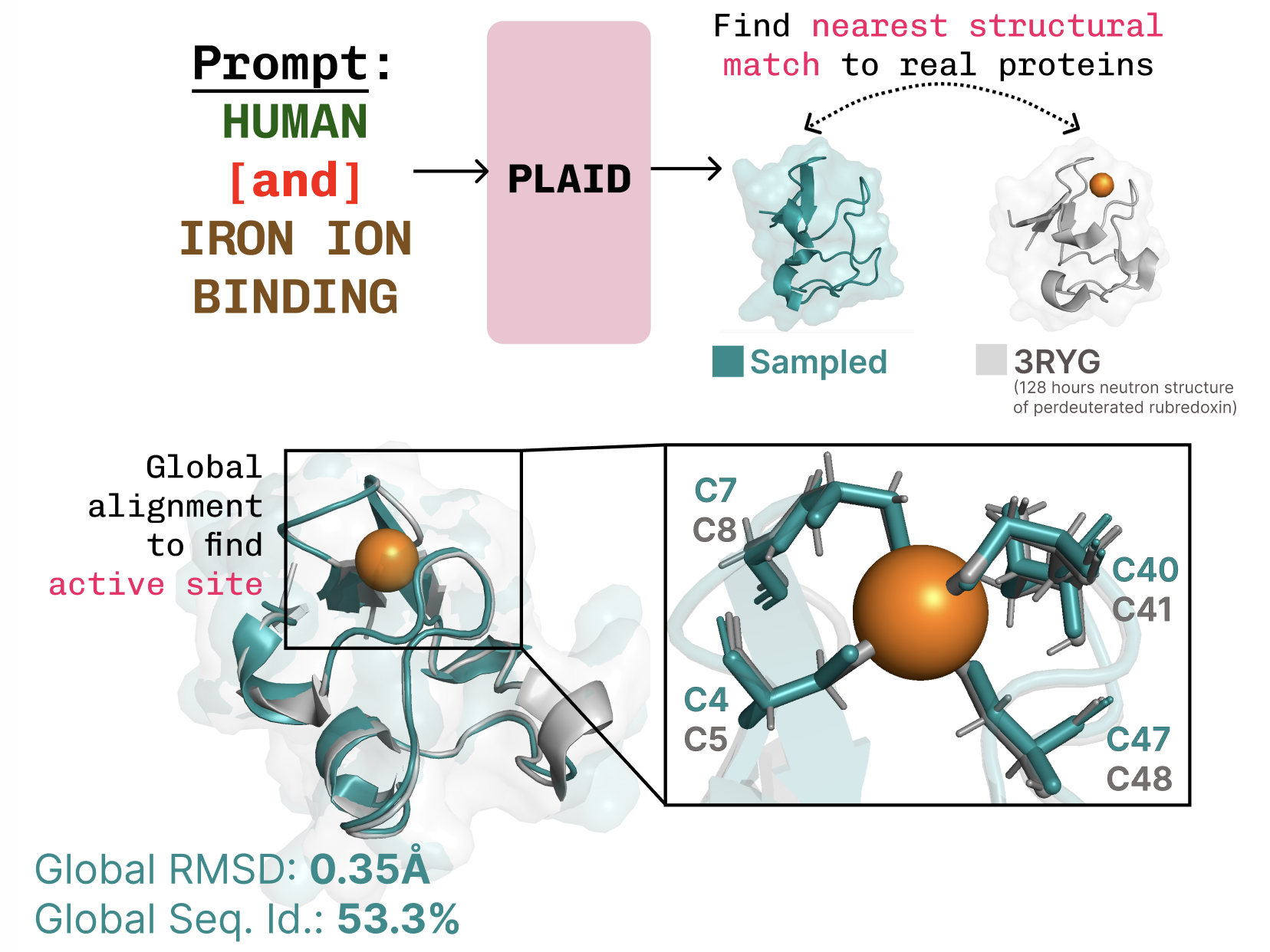
• PLAID uses latent diffusion to generate protein 1D sequences and 3D structures simultaneously. • It learns from protein folding models’ latent space, enabling multimodal co‑generation of discrete sequences and continuous coordinates. • Supports compositional function and organism prompts, trained on vast sequence databases (2‑4 orders larger than structure sets). • Addresses key limitations: all‑atom generation, organism specificity, and control specification for drug‑design relevance. • Builds on AlphaFold2’s success, aiming to move beyond folding to practical protein design and therapeutics. • Future interface could let users specify constraints like solubility, delivery format, or immune compatibility.
Article Summaries:
- PLAID: A Multimodal Protein Generator Using Latent Diffusion
Following the 2024 Nobel Prize awarded to AlphaFold2, researchers have introduced PLAID, a generative model that simultaneously produces protein 1‑D sequences and all‑atom 3‑D structures. PLAID learns a diffusion process over the latent space of existing folding models, enabling it to generate new proteins from large sequence databases-2-4 orders of magnitude larger than structural datasets-without requiring structural training data. The model supports multimodal co‑generation, organism‑specific “humanization,” and compositional textual prompts for function and other constraints, aiming to bridge the gap between protein design and practical drug development.
Sources: