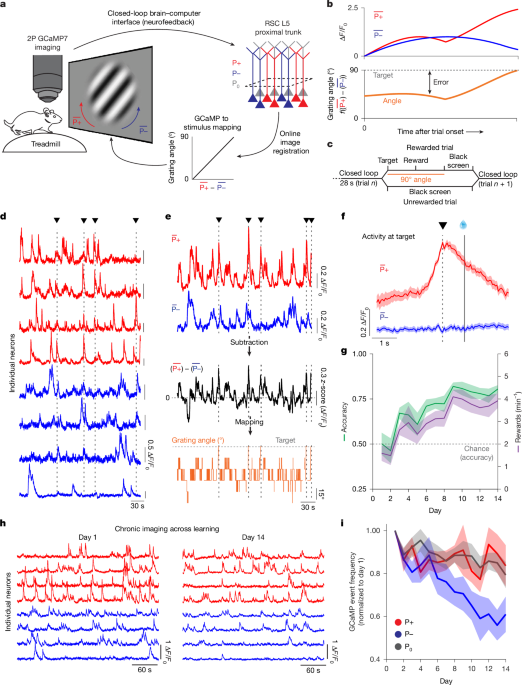
• Abstract Vectorization of teaching signals is a key element of almost all modern machine learning algorithms, including backpropagation, target propagation and reinforcement learning • Vectorization allows a scalable and computationally efficient solution to the credit assignment problem by tailoring instructive signals to individual neurons • Recent theoretical models have suggested that neural circuits could implement single-phase vectorized learning at the cellular level by processing feedforward and feedback information streams in separate dendritic compartments1,2,3,4,5 • This presents a compelling, but untested, hypothesis for how cortical circuits could solve credit assignment in the brain • Here we used a neurofeedback brain-computer interface task with an experimenter-defined reward function to test for vectorized instructive signals in dendrites • We trained mice to modulate the activity of two spatially intermingled populations (four or five neurons each) of layer 5 pyramidal neurons in the retrosplenial cortex to rotate a visual grating towards a target orientation while we recorded GCaMP activity from somas and corresponding distal apical dendrites
Article Summaries:
- Abstract Vectorization of teaching signals is a key element of almost all modern machine learning algorithms, including backpropagation, target propagation and reinforcement learning. Vectorization allows a scalable and computationally efficient solution to the credit assignment problem by tailoring instructive signals to individual neurons. Recent theoretical models have suggested that neural circuits could implement single-phase vectorized learning at the cellular level by processing feedforward and feedback information streams in separate dendritic compartments1,2,3,4,5. This presents a com
Sources:
- https://www.nature.com/articles/s41586-026-10190-7 (Latest source article published: 2026-02-25 17:32 UTC)