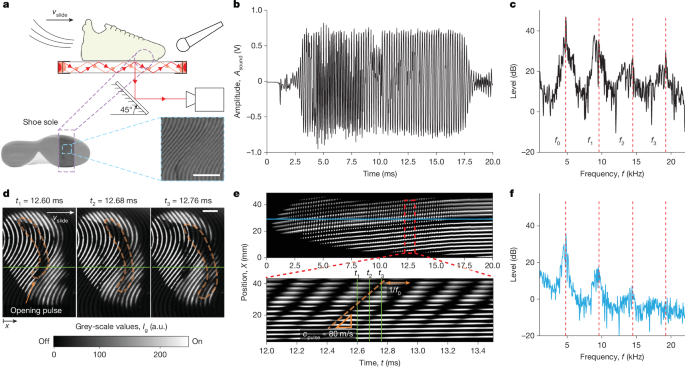
• Abstract Squeaking is a constant companion in various aspects of our daily lives, whether we slide rubber-soled shoes across hardwood floors1, scrape chalk on a blackboard2, engage the brakes on a bicycle3 or walk with a hip replacement4,5 • When two rigid bodies slide over each other, squeaking is widely understood to result from self-excited stick-slip oscillations, triggered by a decrease in the friction coefficient with increasing slip velocity6,7,8,9,10 • However, sliding of extended interfaces can involve crack or slip-pulse propagation11,12,13,14,15,16,17,18,19,20,21 • This distinction is amplified when a soft body slides on a rigid one, in which large deformations and material mismatch can cause detachment by opening slip pulses22,23,24,25,26,27 • Previous studies focused mainly on slow sliding17,26,28,29,30,31,32,33,34, in which pulses are slow and squeaking is absent • Although squeaking at soft-rigid interfaces has been linked to stick-slip oscillations35,36,37, the mechanisms remain unclear
Article Summaries:
- Abstract Squeaking is a constant companion in various aspects of our daily lives, whether we slide rubber-soled shoes across hardwood floors1, scrape chalk on a blackboard2, engage the brakes on a bicycle3 or walk with a hip replacement4,5. When two rigid bodies slide over each other, squeaking is widely understood to result from self-excited stick-slip oscillations, triggered by a decrease in the friction coefficient with increasing slip velocity6,7,8,9,10. However, sliding of extended interfaces can involve crack or slip-pulse propagation11,12,13,14,15,16,17,18,19,20,21. This distinction is
Sources:
- https://www.nature.com/articles/s41586-026-10132-3 (Latest source article published: 2026-02-25 17:32 UTC)