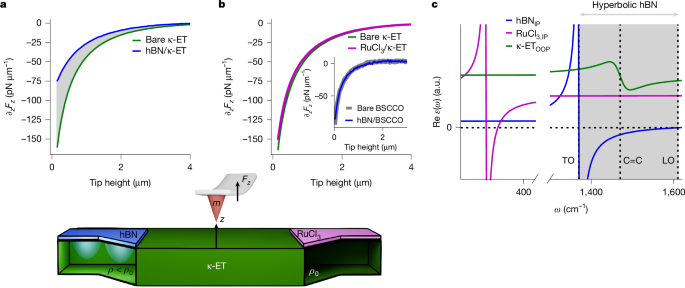
• Abstract Is it feasible to alter the ground-state properties of a material by engineering its electromagnetic environment • Inspired by theoretical predictions1,2,3,4,5,6,7,8,9,10,11,12, experimental realizations of such cavity-controlled properties without optical excitation are beginning to emerge13,14,15,16,17,18,19 • Here we devised and implemented a new platform to realize cavity-altered materials • Single crystals of hyperbolic van der Waals (vdW) compounds provide a resonant electromagnetic environment with enhanced density of photonic states and prominent mode confinement20,21,22,23,24 • We interfaced hexagonal boron nitride (hBN) with the molecular superconductor κ-(BEDT-TTF)2Cu[N(CN)2]Br (κ-ET) • The frequencies of infrared hyperbolic modes (HMs) of hBN (refs
Article Summaries:
- Abstract Is it feasible to alter the ground-state properties of a material by engineering its electromagnetic environment? Inspired by theoretical predictions1,2,3,4,5,6,7,8,9,10,11,12, experimental realizations of such cavity-controlled properties without optical excitation are beginning to emerge13,14,15,16,17,18,19. Here we devised and implemented a new platform to realize cavity-altered materials. Single crystals of hyperbolic van der Waals (vdW) compounds provide a resonant electromagnetic environment with enhanced density of photonic states and prominent mode confinement20,21,22,23,24. W
Sources:
- https://www.nature.com/articles/s41586-025-10062-6 (Latest source article published: 2026-02-25 17:31 UTC)