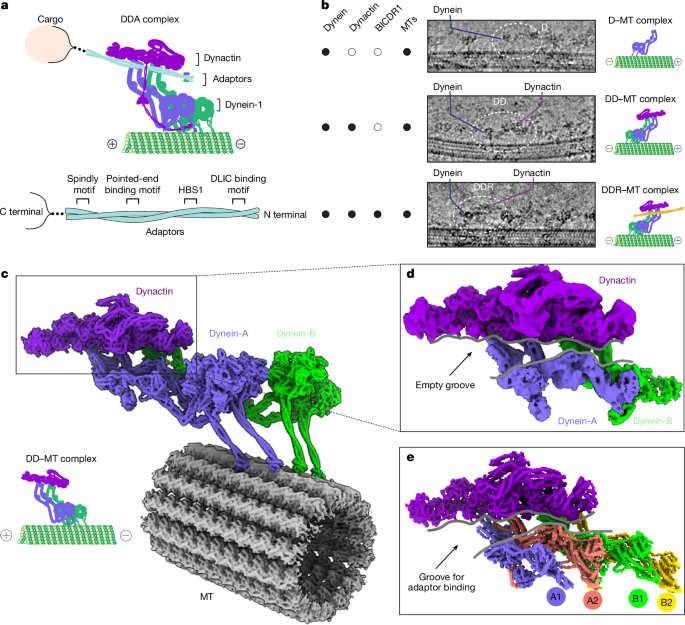
• Abstract Cytoplasmic dynein-1, a microtubule (MT)-based motor protein, requires dynactin and a coiled-coil adaptor to form the processive dynein-dynactin-adaptor (DDA) complex1,2. • The roles of MTs and dynein regulator lissencephaly-1 (LIS1) in DDA assembly have remained elusive. • Here we use cryo-electron microscopy to determine the structural basis of MT- and LIS1-mediated DDA assembly. • We show that an adaptor-independent dynein-dynactin complex spontaneously forms on MTs with an intrinsic 2:1 stoichiometry in a highly efficient manner, driven by parallel alignment of dynein tails upon MT binding. • Adaptors can wedge into and exchange within the assembled MT-bound dynein-dynactin complex; these processes are enabled by relative rotations between dynein and dynactin and facilitated by the dynein light-intermediate chains that assist the adaptor ‘search’ mechanism. • Although LIS1 is dispensable for efficient DD(A)-MT assembly, its presence expands the conformational landscape of DD(A) assemblies on MTs.
Article Summaries:
- Researchers used cryo‑electron microscopy to uncover how microtubules (MTs) and the protein LIS1 orchestrate the assembly of the dynein-dynactin-adaptor (DDA) complex, the motor machinery that drives intracellular transport. They found that dynein and dynactin can spontaneously bind MTs in a 2:1 ratio, forming a stable core complex that can later recruit cargo adaptors. LIS1, while not essential for this initial binding, expands the range of conformations the complex can adopt, stabilizing low‑affinity intermediates that prime dynein for efficient assembly. The study highlights the dynamic flexibility of dynein’s assembly process and the coordinated roles of MTs and LIS1.
Sources: