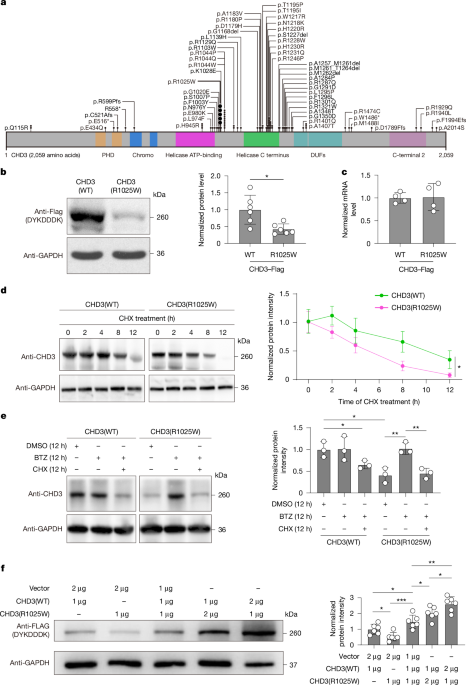
• Abstract Neurodevelopmental disorders that arise from de novo mutations in chromatin-remodelling genes lack targeted treatments. • Snijders Blok-Campeau syndrome (SNIBCPS)1, which is caused by pathogenic variants in CHD3, manifests with intellectual disability, autistic-like behaviours and motor deficits2. • Whether somatic gene correction can reverse such phenotypes in vivo remains unknown. • Here we show that modelling the recurrent CHD3 variant p.R1025W in a humanized mouse model (Chd3hR1025W/+) recapitulates key features of SNIBCPS, including reduced CHD3 protein levels and abnormalities in social communication, cognition and motor coordination. • We engineered a TadA-embedded adenine base editor (TeABE) and delivered it brain-wide using a dual adeno-associated virus (AAV) system and achieved efficient on-target A•T-to-G•C correction across multiple cortical and hippocampal regions with minimal bystander activity. • This intervention restored CHD3 levels and ameliorated behavioural abnormalities in vivo.
Article Summaries:
- Researchers engineered a brain‑wide adenine base editor (TeABE) delivered by a dual adeno‑associated virus (AAV) system to correct a pathogenic CHD3 mutation (p.R1025W) in a humanized mouse model. The editing achieved efficient A•T‑to‑G•C conversion across cortical and hippocampal neurons with minimal bystander effects, restoring CHD3 protein levels and rescuing social, cognitive, and motor deficits characteristic of Snijders Blok-Campeau syndrome. Parallel intrathecal delivery in nonhuman primates produced widespread neuronal transduction and effective base editing, supporting translational potential. The study demonstrates that precise single‑base correction in the post‑natal brain can reverse neurodevelopmental phenotypes, offering a framework for monogenic disorder therapy.
Sources: