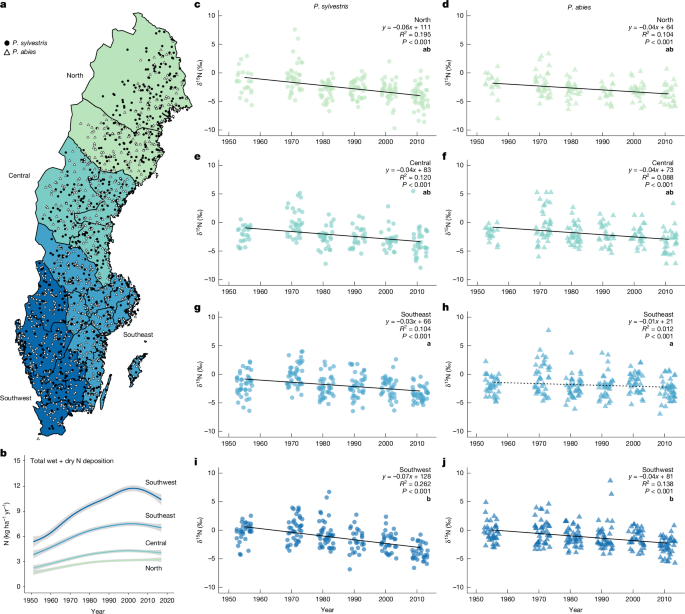
• Abstract Anthropogenic nitrogen (N) pollution is a cause of eutrophication globally1. • However, recent datasets indicate that some ecosystems may be experiencing widespread oligotrophication-declining N availability-which is suggested to be a response to elevated atmospheric carbon dioxide (CO2)2. • Plant N isotope (δ15N) chronologies have served as primary evidence for oligotrophication, but there is wide disagreement whether rising CO2 or temporal changes in N deposition explain these patterns3,4,5,6. • Here we construct δ15N tree-ring chronologies using archived samples from Sweden’s 23.5-million-hectare forest area from 1961 to 2018. • The study area spans a 1,500-km latitudinal distance where N deposition varies fourfold, but where rising CO2 is spatially uniform. • Our data show declining δ15N chronologies throughout Sweden, including forests in the far north where atmospheric N deposition rates are very low.
Article Summaries:
- A study of Swedish boreal forests (1961‑2018) used tree‑ring nitrogen isotope (δ¹⁵N) records to assess changes in soil nitrogen availability. Across a 1,500‑km latitudinal transect, δ¹⁵N values declined steadily, even in northern sites with low nitrogen deposition. Statistical models identified rising atmospheric CO₂ as the strongest predictor of this trend, while variations in nitrogen deposition, temperature, and forest basal area explained far less variation. The results suggest that elevated CO₂ is driving “oligotrophication” - reduced nitrogen availability - in boreal ecosystems, potentially limiting future carbon uptake and altering the forests’ role as a global carbon sink.
Sources: