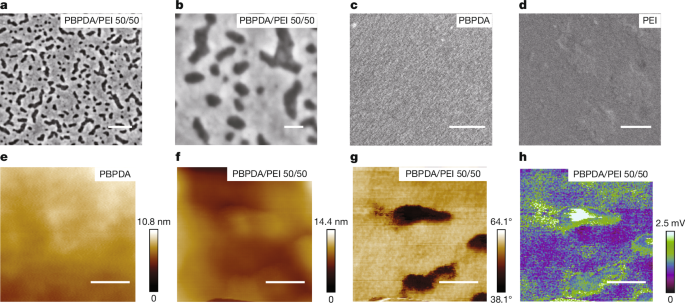
• Abstract Dielectric polymers used in electrical energy storage require a combination of key metrics, including a high dielectric constant (K), low loss and high breakdown strength (Eb), all while being capable of operating at high temperatures1,2,3,4,5,6. • Decades of research into polymer-inorganic composites have achieved only limited success in reaching these goals5,7,8. • Here we introduce high-temperature immiscible blends of two dipolar polymers that, through nanophase separation, self-assemble into three-dimensional all-polymer nanocomposites. • The resulting nanostructures induce coiled-chain morphology and large conformation changes, which, combined with relatively low rotational barrier and high dipole moments of both polymers, yield ultrahigh dielectric responses (K > 13) while maintaining a low loss (tanδ approximately 0.002) across a wide temperature range. • Simultaneously, the nanostructured interfaces act as barriers for mobile charges, markedly reducing conduction losses at high fields and temperatures. • The all-polymer three-dimensional nanocomposites with concurrently high K, high Eb and low loss deliver unprecedented discharged energy densities at elevated temperatures (18.7 J cm−3, 15.1 J cm−3 and 8.6 J cm−3 at 150 °C, 200 °C and 250 °C, respectively).
Article Summaries:
- Researchers have engineered a new class of all‑polymer nanocomposites that achieve record‑high energy storage at elevated temperatures. By blending two immiscible dipolar polymers, they induce nanophase separation that self‑assembles into three‑dimensional structures. These nanostructures produce a coiled‑chain morphology and large conformational changes, yielding a dielectric constant above 13 while maintaining an exceptionally low loss (tan δ ≈ 0.002) across a wide temperature range. The interfaces also block mobile charges, enhancing breakdown strength. The resulting materials deliver unprecedented discharged energy densities of 18.7 J cm⁻³ at 150 °C, 15.1 J cm⁻³ at 200 °C, and 8.6 J cm⁻³ at 250 °C, and the approach is applicable to other dipolar blends.
Sources: