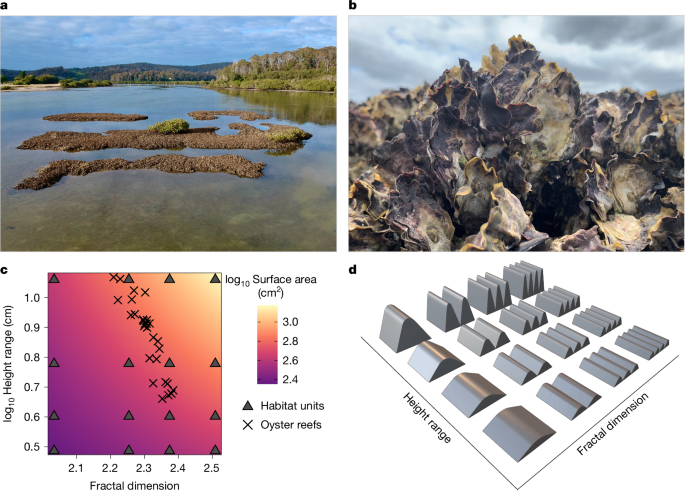
• Abstract The three-dimensional architecture of natural habitats is a key determinant of species biodiversity, harvestable biomass and resilience to disturbance1,2. • Indeed, some species, including trees, corals and oysters, alter resource availability and modify biotic and abiotic pressures through their own three-dimensional structures-thereby enhancing their own survival3,4. • However, which aspects of the three-dimensional architecture of these ecosystem engineers shape ecosystem dynamics and species survival are rarely examined by empirical studies, leaving much of the broader ecological and conservation impact of ecosystem engineering underexplored4,5,6. • Here we show that oyster reefs have combinations of geometric variables that maximize recruit survival, which is a key factor influencing oyster reef growth and persistence. • Using three-dimensional habitat designs that capture the full spectrum of natural oyster reef architectures, as well as a geometric theory7 that links habitat surface area, fractal dimension and height, we show that oyster settlement and survival are greatest at particular combinations of fractal dimension and height that minimize predation. • Our study provides a template for understanding optimal three-dimensional habitat configurations for habitat restoration projects that are proliferating globally, without targeting key architectural features of habitat space that maximize restoration success8,9.
Article Summaries:
- Scientists have shown that the three‑dimensional shape of natural oyster reefs directly boosts the survival of newly settled oysters. By measuring reef surface area, fractal dimension and height, researchers identified specific combinations that reduce predation and enhance recruitment. The study used realistic 3‑D reef models and a geometric theory linking habitat structure to survival rates. Findings suggest that restoration projects should target these optimal architectural features-rather than merely recreating reef size-to improve long‑term growth and resilience. The work provides a quantitative framework for designing oyster reefs that maximize biodiversity and ecosystem function.
Sources: