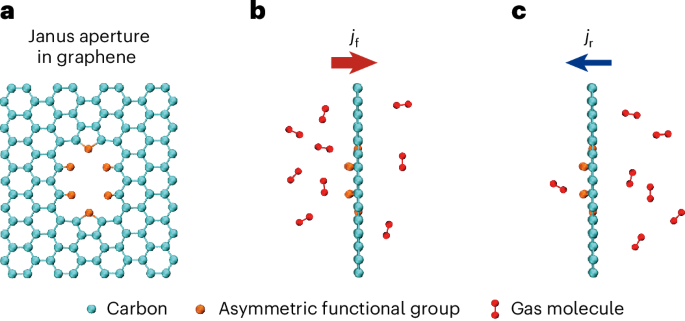
• Abstract Directional mass transport in confined space is crucial to life and the water-energy-environment nexus • Despite progress in understanding biological and designing artificial ionic diodes at the atomic scale, rectifying charge-neutral molecular flow remains a challenge • Here we explore gas transport through an ångström-sized Janus aperture in graphene, which is created by feedback-controlled ozone etching and features oxygen-containing functional groups asymmetrically distributed around the edge • Ten representative gases with molecules of varying compositions, shapes and sizes were measured • The permeation coefficients indicate energy barrier-controlled transport • Rectified flow was consistently observed for seven different species including krypton, xenon, hydrogen, oxygen, nitrogen, carbon dioxide and nitrous oxide, with rectification ratios of up to two orders of magnitude for oxygen
Article Summaries:
- Abstract Directional mass transport in confined space is crucial to life and the water-energy-environment nexus. Despite progress in understanding biological and designing artificial ionic diodes at the atomic scale, rectifying charge-neutral molecular flow remains a challenge. Here we explore gas transport through an ångström-sized Janus aperture in graphene, which is created by feedback-controlled ozone etching and features oxygen-containing functional groups asymmetrically distributed around the edge. Ten representative gases with molecules of varying compositions, shapes and sizes were mea
Sources:
- https://www.nature.com/articles/s41563-026-02513-w (Latest source article published: 2026-02-26 07:32 UTC)