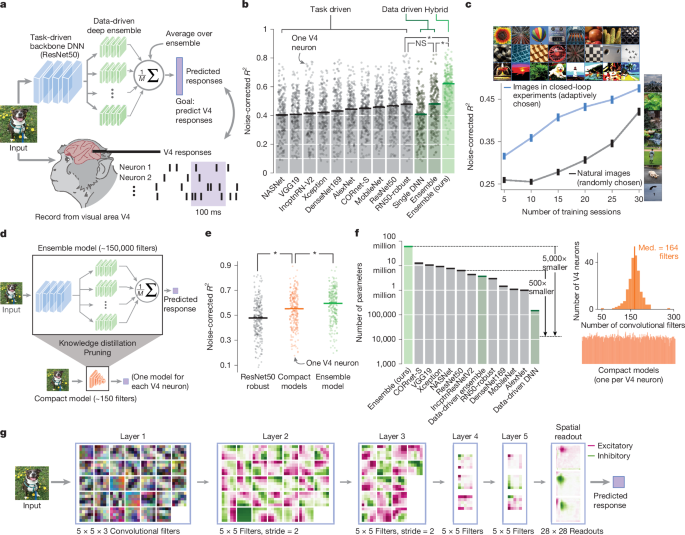
• Abstract A powerful approach to understand the computations carried out by the visual cortex is to build models that predict neural responses to any arbitrary image • Deep neural networks (DNNs) have emerged as the leading predictive models1,2, yet their underlying computations remain buried beneath millions of parameters • Here we challenge the need for models at this scale by seeking predictive and parsimonious DNN models of the primate visual cortex • We first built a highly predictive DNN model of neural responses in macaque visual area V4 by alternating data collection and model training in adaptive closed-loop experiments • We then compressed this large, black-box DNN model, which comprised 60 million parameters, to identify compact models with 5,000 times fewer parameters yet comparable accuracy • This dramatic compression enabled us to investigate the inner workings of the compact models
Article Summaries:
- Abstract A powerful approach to understand the computations carried out by the visual cortex is to build models that predict neural responses to any arbitrary image. Deep neural networks (DNNs) have emerged as the leading predictive models1,2, yet their underlying computations remain buried beneath millions of parameters. Here we challenge the need for models at this scale by seeking predictive and parsimonious DNN models of the primate visual cortex. We first built a highly predictive DNN model of neural responses in macaque visual area V4 by alternating data collection and model training in
Sources:
- https://www.nature.com/articles/s41586-026-10150-1 (Latest source article published: 2026-02-25 17:31 UTC)