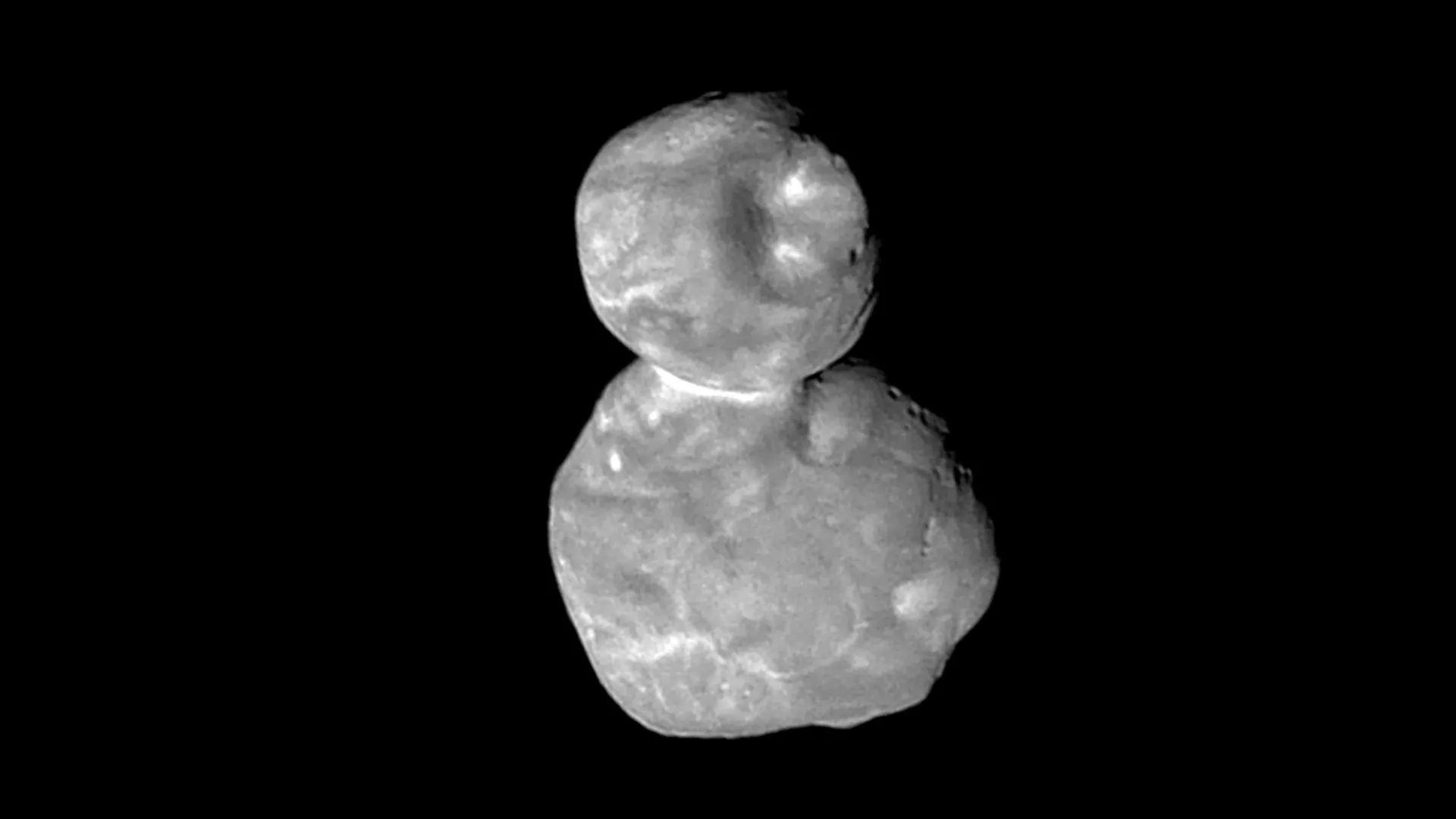
• Why the outer solar system is filled with giant cosmic â snowmenâ Cosmic snowmen beyond Neptune may be the natural result of gravity quietly at work. • For decades, astronomers have tried to understand why so many icy bodies in the outer solar system resemble snowmen, with two rounded sections joined together. • Researchers at Michigan State University now report evidence pointing to a surprisingly straightforward process that can explain how these unusual shapes form. • Beyond the turbulent asteroid belt between Mars and Jupiter lies the Kuiper Belt, a distant region past Neptune filled with frozen remnants from the solar system’s earliest days. • These primitive objects, known as planetesimals, are leftover building blocks from planet formation. • About 10 percent of them are classified as contact binaries, meaning they consist of two connected lobes that give them a snowman-like appearance.
Article Summaries:
- Researchers at Michigan State University have shown that the “snowman‑shaped” contact binaries common in the Kuiper Belt can form naturally through simple gravitational collapse. A new computer simulation, published in the Monthly Notices of the Royal Astronomical Society, models planetesimals retaining structural strength, allowing two lobes to settle together rather than merge into a single sphere. This contrasts with earlier fluid‑based models that produced only smooth spheres. The study explains why roughly 10 % of Kuiper Belt objects exhibit this two‑lobed shape without invoking rare collision events, offering a straightforward mechanism for early solar‑system planetesimal formation.
Sources: