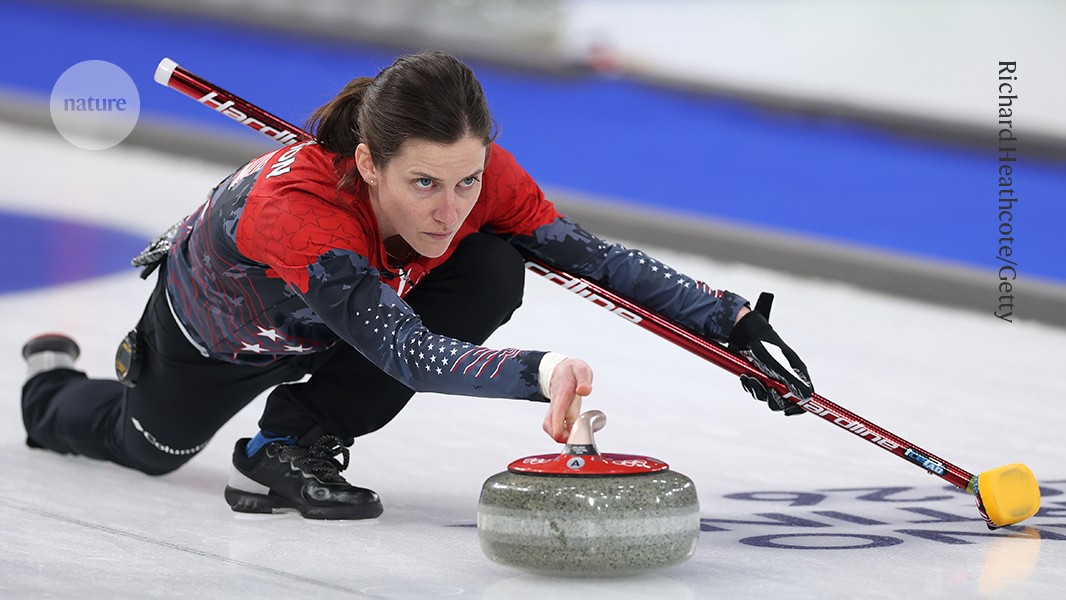
• Curling stones weigh ~19 kg, made of granite, slide across pebbled ice toward target. • Players apply spin; clockwise spin makes stone curl right, counterintuitive to everyday physics. • Pebbled surface reduces friction, allowing stone to glide and respond to spin. • Sweeping warms ice, decreasing resistance, extending stone’s travel distance. • Physicists still debate why spin direction causes opposite curvature compared to flat surfaces. • Research continues to unravel complex interactions between stone, ice, and motion.
Article Summaries:
- Scientists continue to investigate why curling stones move opposite to the expected direction when spun. Despite over a century of study, no consensus has emerged. Two leading explanations compete: one proposes that the stone’s running band scratches the pebbled ice, causing the back end to catch and veer right; the other, a pivot‑slide model, suggests the stone’s motion consists of repeated small pivots that accumulate into the overall curl. Recent research, including a 2016 paper, supports the pivot‑slide idea, but further experiments are needed to confirm which mechanism dominates. The mystery remains a key focus for winter‑sports physicists.
Sources: