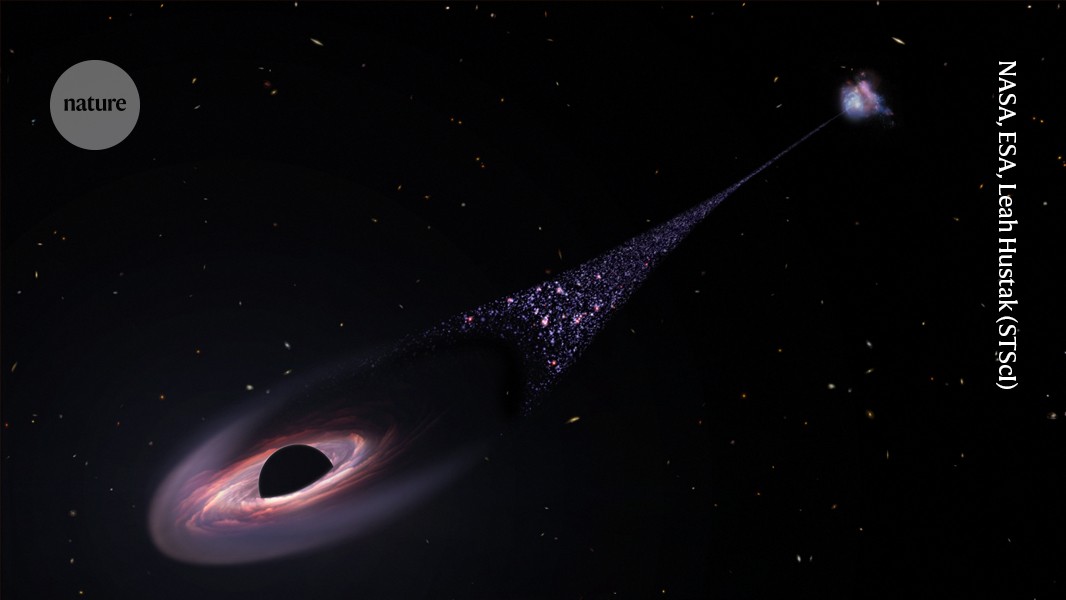
• Email Bluesky Facebook LinkedIn Reddit Whatsapp X A black hole (bottom left; artist’s illustration) that has escaped from its host galaxy leaves a trail of young stars in its wake. • Credit: NASA, ESA, Leah Hustak (STScI) A ‘runaway’ black hole ejected from its host galaxy is barrelling across space - and leaving behind a wake of newborn stars. • Access options Access Nature and 54 other Nature Portfolio journals Get Nature+, our best-value online-access subscription 27,99 €/ 30 days cancel any time Subscribe to this journal Receive 51 print issues and online access 185,98 € per year only 3,65 € per issue Rent or buy this article Prices vary by article type from$1.95 to$39.95 Prices may be subject to local taxes which are calculated during checkout doi: https://doi.org/10.1038/d41586-026-00510-2 References van Dokkum, P.et al.Astrophys. • J.946, L50 (2023).ArticleGoogle Scholar van Dokkum, P.et al.Astrophys. • ArticleGoogle Scholar van Dokkum, P.et al.Astrophys. • J.998, L27 (2026).ArticleGoogle Scholar van Dokkum, P.et al.Astrophys.
Article Summaries:
- A recent study reports the first clear evidence of a “runaway” black hole moving through a galaxy and leaving a trail of stars in its wake. Using deep imaging and spectroscopic data, astronomers identified a compact, high‑velocity object that has stripped stars from its host galaxy, creating a linear stellar stream. The findings, published in Nature and based on observations from the Hubble Space Telescope and ground‑based facilities, suggest that such black holes can be ejected by gravitational interactions or mergers. The work builds on earlier papers by van Dokkum et al. (2023, 2026) and highlights a new mechanism for galaxy evolution.
Sources: