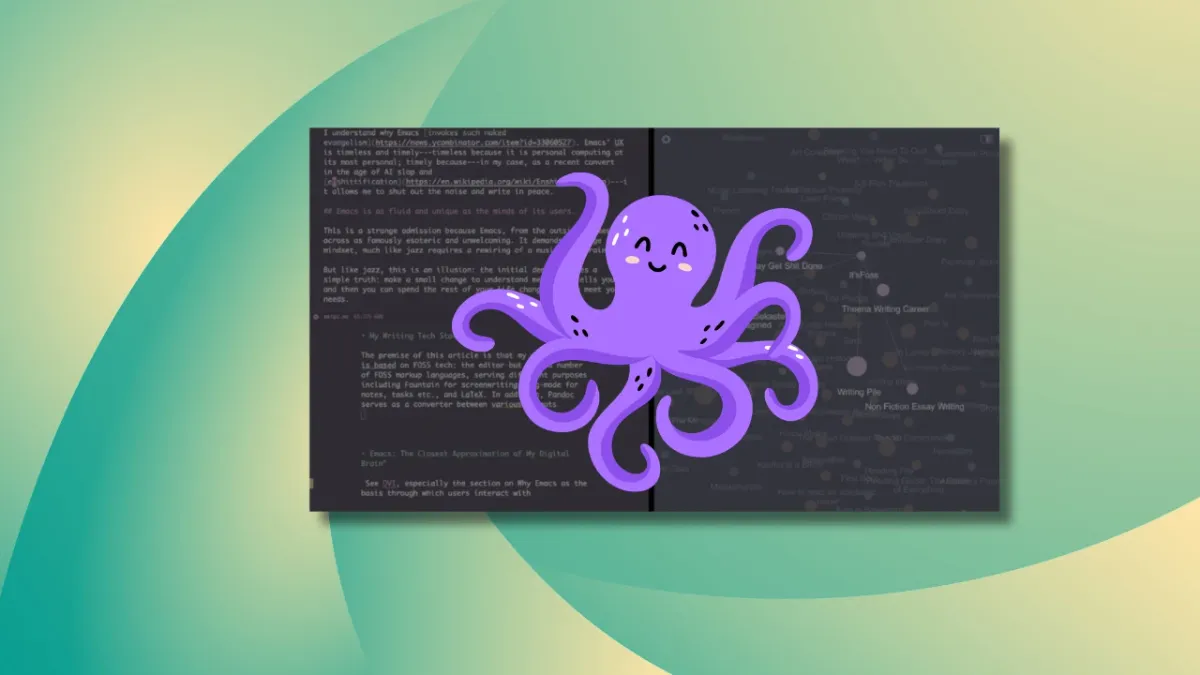
• Why and How I am Using Emacs for Writing My Next Novel The author working on his manuscript. • The screen is divided between the LaTeX manuscript, its PDF, and the notes in org-mode.©Theena Kumargurunathan, 2026 In Part I of this article, I alluded to how Emacs’ UX has allowed me to create a writing workflow to fit the way I think, write, edit and worldbuild. • But Emacs is more than my tool for thinking and writing: it is also direct inspiration for a Brain-Computer Interface (BCI) for my next science fiction novel. • Much of the dramatic extrapolations for this BCI came from experience: imaginative extrapolation is easy when the tool itself feels both timeless and futuristic. • In part II, I want to use a different route. • I will start by tracing a brief historical outline of the philosophical and design choices that has made Emacs a veritable digital habitat for writers like me.
Article Summaries:
- The article explains how the author uses Emacs as a flexible writing environment for his upcoming novel, noting that its user‑centric design and modularity allow writers to shape the tool to fit their workflow. Emacs’ emphasis on plain text, buffers, and lightweight modes (e.g., word counts, spell‑check, exports) makes it a “digital habitat” that supports brainstorming, research, and drafting without switching apps. The author also highlights how Emacs’ historical evolution-starting from terminals, adding a GUI, and integrating version control via Magit-has kept it adaptable while preserving readability. Finally, he points out that the editor’s timeless feel and modularity inspire the speculative brain‑computer interface concept in his science‑fiction novel.
Sources: