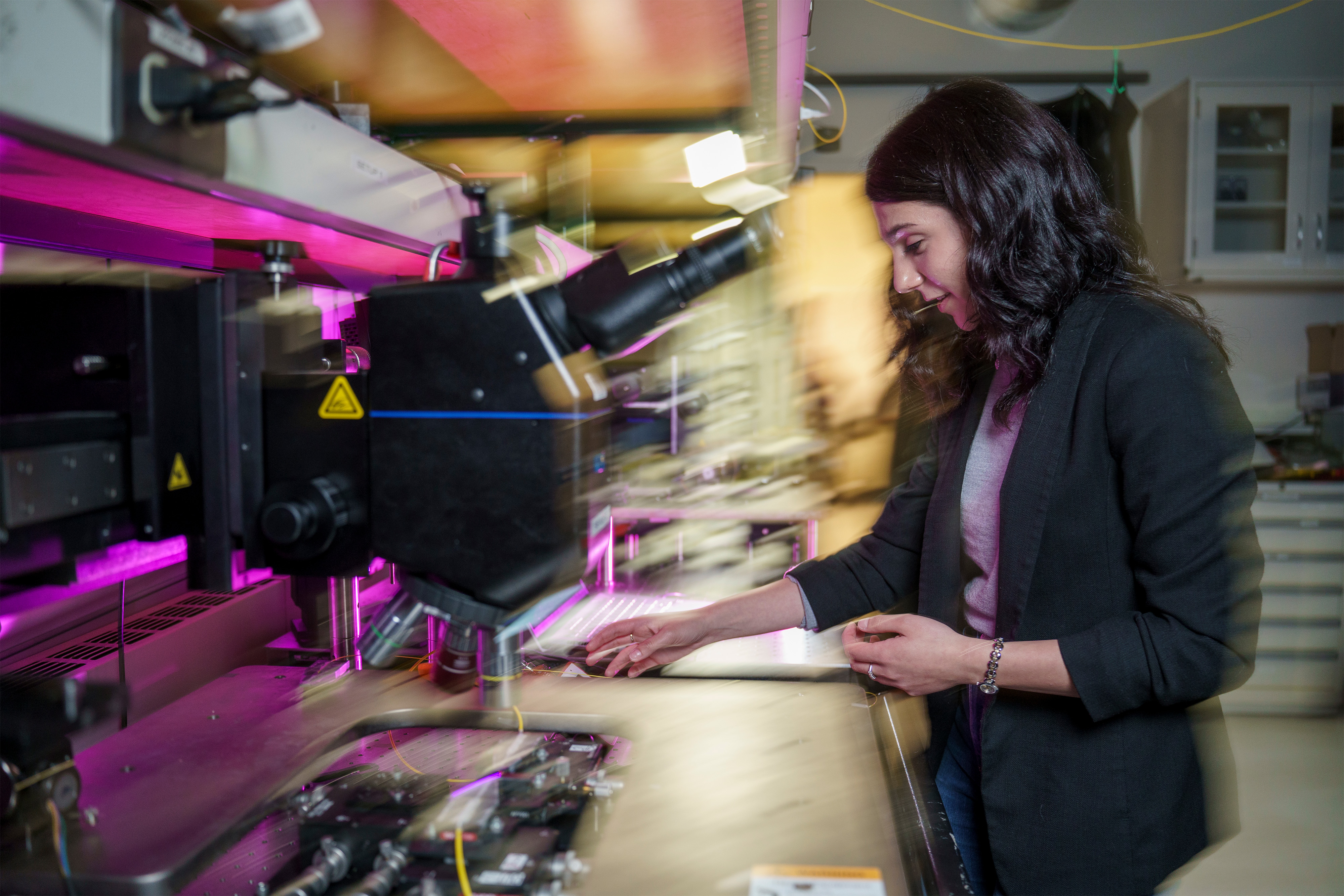
• Breadcrumb MIT News The high-tech wizardry of integrated photonics The high-tech wizardry of integrated photonics Press Contact: Media Download *Terms of Use: Images for download on the MIT News office website are made available to non-commercial entities, press and the general public under aCreative Commons Attribution Non-Commercial No Derivatives license. • You may not alter the images provided, other than to crop them to size. • A credit line must be used when reproducing images; if one is not provided below, credit the images to “MIT.” Previous imageNext image Audio Inspired by the “Harry Potter” stories and the Disney Channel show “Wizards of Waverly Place,” 7-year-old Sabrina Corsetti emphatically declared to her parents one afternoon that she was, in fact, a wizard. • “My dad turned to me and said that, if I really wanted to be a wizard, then I should become a physicist. • Physicists are the real wizards of the world,” she recalls. • That conversation stuck with Corsetti throughout her childhood, all the way up to her decision to double-major in physics and math in college, which set her on a path to MIT, where she is now a graduate student in the Department of Electrical Engineering and Computer Science.
Article Summaries:
- MIT graduate student Sabrina Corsetti, a physics‑math double major from the University of Michigan, is advancing integrated photonics-chips that route light instead of electricity. Her work in Professor Jelena Notaros’s Photonics and Electronics Research Group includes a palm‑sized 3‑D printer that uses a reconfigurable light beam to cure resin, a miniature “tractor beam” that captures and moves biological particles on a chip, and a trapped‑ion quantum‑computing project in partnership with MIT Lincoln Laboratory. Corsetti’s research aims to create compact, scalable optical devices for communications, sensing, and biomedical applications, illustrating the practical impact of photonic engineering.
Sources: