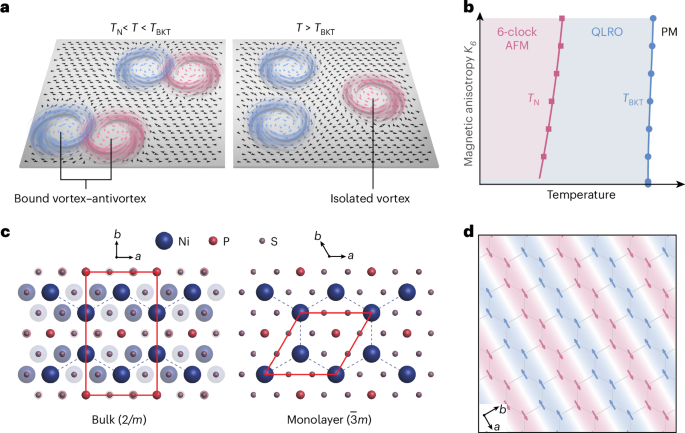
• Abstract The study of collective behaviour driven by spontaneous symmetry breaking and topology is crucial for understanding phase transitions in quantum matter. • The two-dimensional (2D) XY model, describing spins with continuous in-plane rotational symmetry, hosts the topological Berezinskii-Kosterlitz-Thouless (BKT) transition, where vortex-antivortex binding induces quasi-long-range order. • This model was later extended to include anisotropy fields, leading to the six-state clock model, which predicts the instability of the BKT phase toward true long-range order at low temperatures. • Here we investigate this physics in the van der Waals antiferromagnet NiPS3 using nonlinear optical micropolarimetry. • As the material is thinned to a monolayer, its magnetic response switches abruptly from the 3D XXZ behaviour of multilayers to a distinct 2D regime consistent with a BKT state. • Upon further cooling, the monolayer BKT phase becomes unstable and transforms into a pinned state with long-range order.
Article Summaries:
- Researchers have observed a Berezinskii-Kosterlitz-Thouless (BKT) transition in the atomically thin antiferromagnet NiPS₃, a van der Waals material. Using nonlinear optical micropolarimetry, they found that when the crystal is thinned to a single layer, its magnetic response abruptly changes from the three‑dimensional XXZ behavior seen in multilayers to a two‑dimensional regime that matches the predictions of the six‑state clock model. Upon further cooling, the monolayer BKT phase destabilizes and locks into a pinned state with true long‑range order. Monte‑Carlo simulations support the experimental findings, highlighting NiPS₃ as a promising platform for studying spin vortices and topological dynamics in two‑dimensional antiferromagnets.
- Abstract The study of collective behaviour driven by spontaneous symmetry breaking and topology is crucial for understanding phase transitions in quantum matter. The two-dimensional (2D) XY model, describing spins with continuous in-plane rotational symmetry, hosts the topological Berezinskii-Kosterlitz-Thouless (BKT) transition, where vortex-antivortex binding induces quasi-long-range order. This model was later extended to include anisotropy fields, leading to the six-state clock model, which predicts the instability of the BKT phase toward true long-range order at low temperatures. Here we
Sources:
- https://www.nature.com/articles/s41563-026-02516-7 (Latest source article published: 2026-02-25 06:47 UTC)