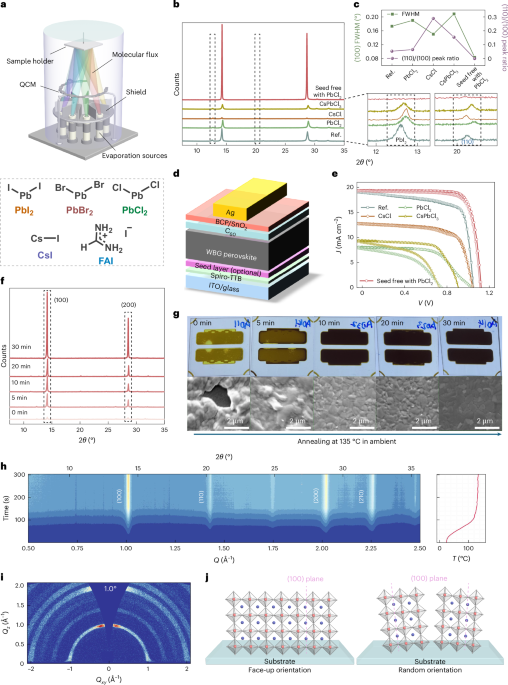
• Abstract Vacuum-based deposition is a scalable, solvent-free industrial method ideal for uniform coatings on complex substrates. • However, all-vacuum-deposited perovskite solar cells fabricated by thermal evaporation trail solution-processed counterparts in efficiency and stability due to film quality challenges, necessitating advancement and improved understanding. • Here, we report a co-evaporation route for 1.67-eV wide-bandgap perovskites by introducing a PbCl2 co-source to optimize film quality. • We promote perovskite formation with pronounced (100) ‘face-up’ orientation and deliver a certified all-vacuum-deposited solar cell with 18.35% efficiency (19.3% in the laboratory) for 0.25-cm2 devices (18.5% for 1-cm2 cells). • These cells retain 80% of peak efficiency after 1,080 h under the ISOS-L-2 protocol. • Leveraging operando hyperspectral imaging, we provide spatiotemporal spectral insight into halide segregation and trap-mediated recombination, correlating microscopic luminescence features with macroscopic device performance while distinguishing radiative from non-ideal recombination channels.
Article Summaries:
- Researchers have advanced all‑vacuum‑deposited perovskite solar cells by introducing a PbCl₂ co‑source during thermal evaporation. This approach promotes a pronounced (100) “face‑up” crystal orientation, yielding a certified 18.35 % efficiency (19.3 % in the laboratory) for 0.25‑cm² devices and 18.5 % for 1‑cm² cells. The cells retain 80 % of their peak power after 1,080 h under the ISOS‑L‑2 protocol. Operando hyperspectral imaging revealed detailed insights into halide segregation and trap‑mediated recombination, linking microscopic luminescence to device performance. The team also demonstrated 27.2 % efficient 1‑cm² perovskite‑on‑silicon tandems that maintained ~80 % of initial output after eight months of outdoor testing in Italy.
- Abstract Vacuum-based deposition is a scalable, solvent-free industrial method ideal for uniform coatings on complex substrates. However, all-vacuum-deposited perovskite solar cells fabricated by thermal evaporation trail solution-processed counterparts in efficiency and stability due to film quality challenges, necessitating advancement and improved understanding. Here, we report a co-evaporation route for 1.67-eV wide-bandgap perovskites by introducing a PbCl2 co-source to optimize film quality. We promote perovskite formation with pronounced (100) ‘face-up’ orientation and deliver a certifi
Sources:
- https://www.nature.com/articles/s41563-026-02494-w (Latest source article published: 2026-02-25 06:47 UTC)