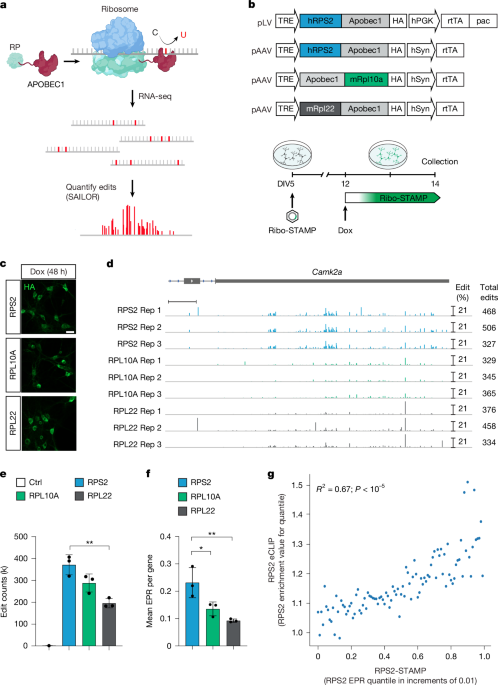
• Abstract The brain displays the richest repertoire of post-transcriptional mechanisms regulating mRNA translation1,2,3,4,5,6,7,8,9,10,11. • Among these, alternative splicing has been shown to drive cell-type specificity and, when disrupted, is strongly linked to neurological disorders12,13,14,15,16,17. • However, genome-wide measurements of mRNA translation with isoform sensitivity at single-cell resolution have not been achieved. • To address this, we deployed Surveying Ribosomal Targets by APOBEC-Mediated Profiling (Ribo-STAMP) coupled with short-read and long-read single-cell RNA sequencing in the brain18. • We generated the first isoform-sensitive single-cell translatomes of the mouse hippocampus at postnatal day 25, discovering cell-type-specific translation of 3,857 alternative transcripts across 1,641 genes and identifying isoforms of the same genes undergoing differential translation within and across 8 different cell types. • We defined high and low translational states in CA1 and CA3 neurons, with synaptic and metabolic genes enriched in high states.
Article Summaries:
- Researchers have developed a new platform that combines Ribo‑STAMP with short‑ and long‑read single‑cell RNA sequencing to map translation at the isoform level in the mouse hippocampus. The study generated the first isoform‑sensitive single‑cell translatomes of postnatal day 25 mice, identifying 3,857 alternative transcripts across 1,641 genes and revealing that the same gene can be differentially translated in distinct cell types. They distinguished high and low translational states in CA1 and CA3 neurons, finding that synaptic and metabolic genes are enriched in high‑state cells and that CA3 neurons exhibit higher basal translation than CA1, confirmed by metabolic labeling and immunohistochemistry. This tool promises deeper insight into how cell‑type‑specific and isoform‑specific translation shapes brain function and disease.
Sources: