• Abstract The severity of malaria varies substantially between individuals, but the mechanisms that underlie these differences remain unclear. • Because erythrocytes have a key role in malaria biology, genetic variants associated with the development of these cells could inform the mechanisms that determine disease severity. • Here we investigate the mechanistic basis of the association of the variant rs112233623-T with erythrocyte properties, and examine its role in modulating malaria severity. • This variant is associated with increased levels of haemoglobin A2, increased erythrocyte size and reduced erythrocyte number1,2. • It is found in an erythroid enhancer of CCND3, which encodes cyclin D3-a cell-division activator that enhances the pentose phosphate pathway and thereby helps to counteract reactive oxygen species (ROS)3. • We show that rs112233623-T disrupts a binding site for the transcription factor SMAD3, weakens enhancer activity and, in erythrocyte precursors (erythroblasts), is associated with reduced CCND3 expression and inhibition of the G1-S cell-cycle transition, concomitant with a reduction in the number of erythrocytes and an increase in their size.
Article Summaries:
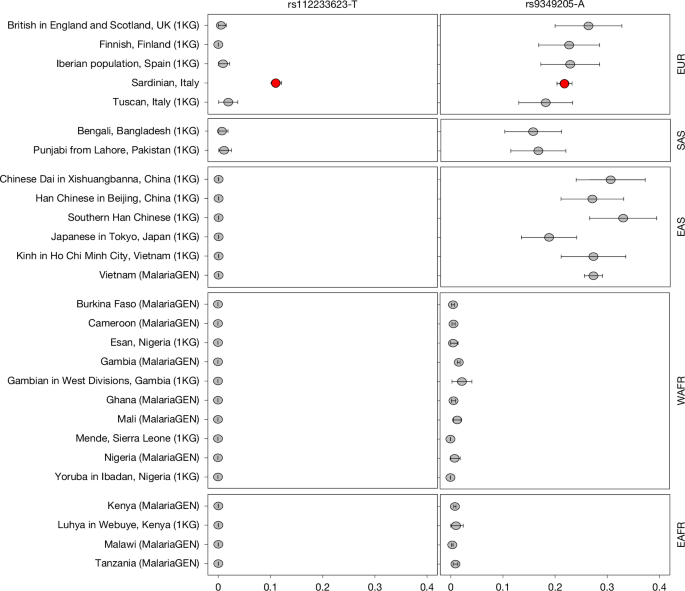
- A recent study links a common genetic variant (rs112233623‑T) in an erythroid enhancer of the CCND3 gene to malaria protection. The variant disrupts a SMAD3 binding site, weakens enhancer activity, and lowers cyclin D3 expression in erythroblasts, causing fewer but larger red blood cells and a stalled G1-S transition. Infected cells from carriers show reduced parasite growth, correlating with higher reactive‑oxygen‑species levels-mirroring the protective effect seen in G6PD‑deficient individuals. Population genetics reveal positive selection for the variant in Sardinia, a former malaria hotspot. The findings suggest that dampening CCND3 could be a novel therapeutic strategy against malaria.
Sources: