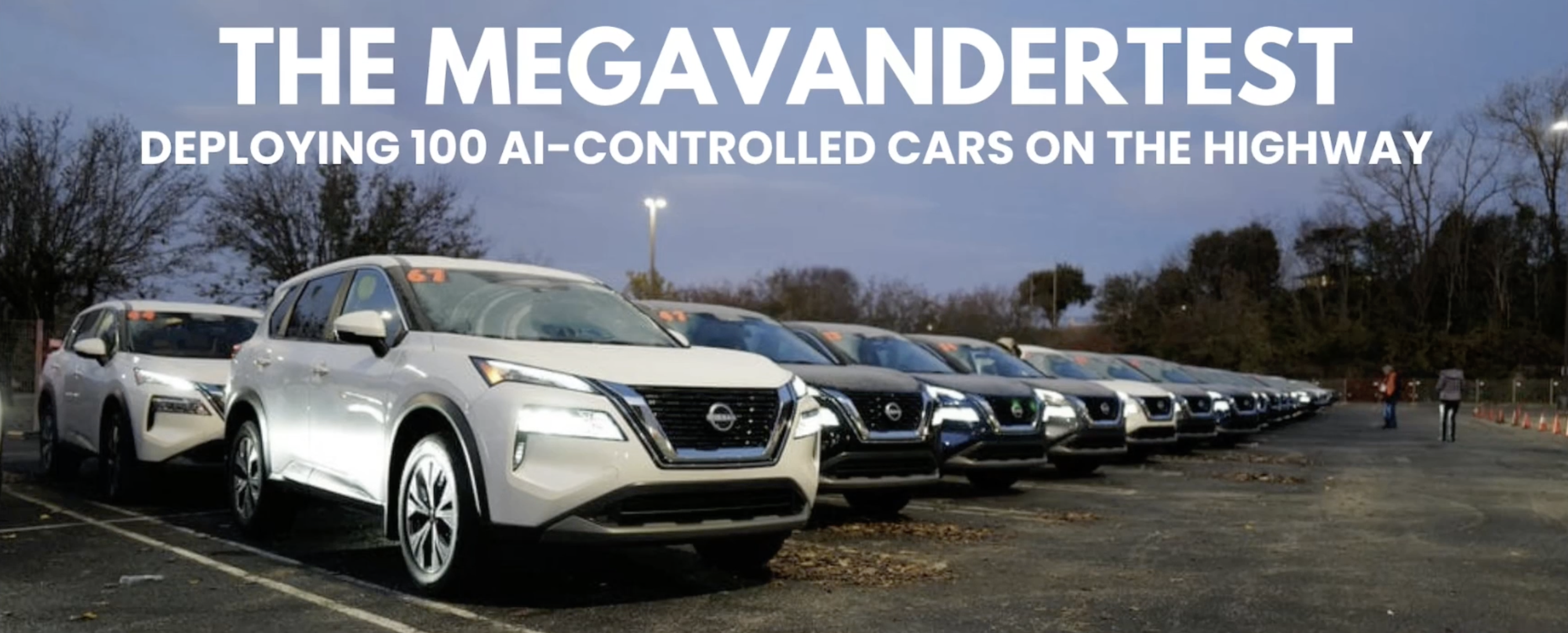
• We deployed 100 reinforcement learning (RL)-controlled cars into rush-hour highway traffic to smooth congestion and reduce fuel consumption for everyone. • Our goal is to tackle “stop-and-go” waves, those frustrating slowdowns and speedups that usually have no clear cause but lead to congestion and significant energy waste. • To train efficient flow-smoothing controllers, we built fast, data-driven simulations that RL agents interact with, learning to maximize energy efficiency while maintaining throughput and operating safely around human drivers. • Overall, a small proportion of well-controlled autonomous vehicles (AVs) is enough to significantly improve traffic flow and fuel efficiency for all drivers on the road. • Moreover, the trained controllers are designed to be deployable on most modern vehicles, operating in a decentralized manner and relying on standard radar sensors. • In our latest paper, we explore the challenges of deploying RL controllers on a large-scale, from simulation to the field, during this 100-car experiment.
Article Summaries:
- We deployed 100 reinforcement learning (RL)-controlled cars into rush-hour highway traffic to smooth congestion and reduce fuel consumption for everyone. Our goal is to tackle “stop-and-go” waves, those frustrating slowdowns and speedups that usually have no clear cause but lead to congestion and significant energy waste. To train efficient flow-smoothing controllers, we built fast, data-driven simulations that RL agents interact with, learning to maximize energy efficiency while maintaining throughput and operating safely around human drivers. Overall, a small proportion of well-controlled au
Sources: