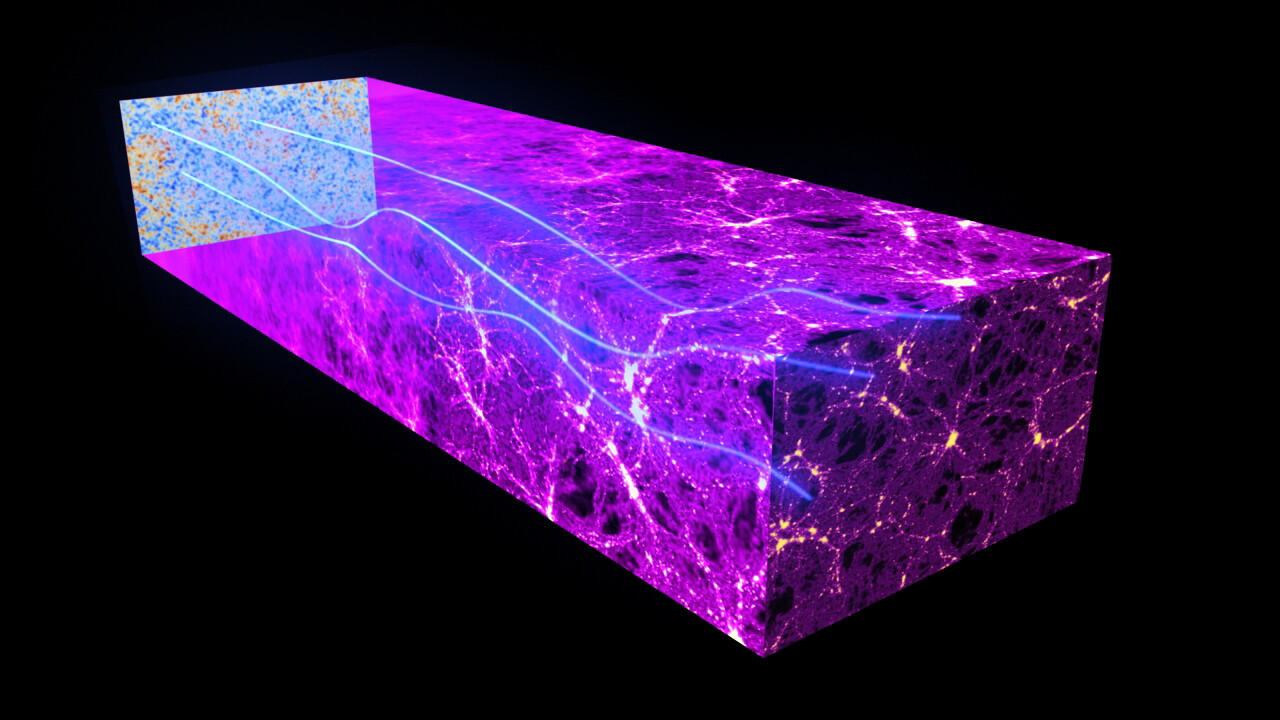
• Observing the Universe’s Teenage Angst with Dropout Galaxies and CMB Lensing byBen Sherwin| Feb 23, 2026 |Daily Paper Summaries|0 comments Title:Cosmology with dropout selection: Straw-man surveys & CMB lensing Authors:M.J. • Wilson and Martin White First Author’s Institution:Lawrence Berkeley National Laboratory, Berkeley Center for Cosmological Physics Status:Published in Journal of Cosmology and Astroparticle Physics [openaccess] Introduction About 380,000 years after the Big Bang, the Universe expanded and cooled enough for electrons and protons to combine into neutral atoms. • This event left behind a nearly uniformblackbodythat we detect today, known as theCosmic Microwave Background (CMB). • The CMB is like the Universe’s baby photo, offering a glimpse into its earliest moments. • On the other hand, galaxy surveys, which map the Universe at the age whenlarge-scale structurehad already formed, are more like adult portraits. • What happened between these two frontiers is less understood.
Article Summaries:
- Wilson and White’s 2026 JCAP paper proposes a new way to map the Universe’s “teenage” epoch (redshifts ≈ 2-5). By selecting Lyman‑break, or dropout, galaxies-bright, high‑redshift objects that show a sharp spectral drop when neutral hydrogen absorbs photons below 912 Å-researchers can trace the underlying matter distribution during a period where most galaxies are faint and dark matter dominates. The authors combine this tracer technique with measurements of cosmic microwave background (CMB) lensing, which directly probes the total mass along the line of sight. Together, the approach bridges the observational gap between the early CMB and later galaxy surveys, offering a more complete picture of structure formation.
- Title: Cosmology with dropout selection: Straw-man surveys & CMB lensing Authors: M.J. Wilson and Martin White First Author’s Institution: Lawrence Berkeley National Laboratory, Berkeley Center for Cosmological Physics Status: Published in Journal of Cosmology and Astroparticle Physics [open access] Introduction About 380,000 years after the Big Bang, the Universe expanded and cooled enough for electrons and protons to combine into neutral atoms. This event left behind a nearly uniform blackbody that we detect today, known as the Cosmic Microwave Background (CMB). The CMB is like the Universe'
Sources:
- https://astrobites.org/2026/02/23/dropout-galaxies-cmb-lensing/ (Latest source article published: 2026-02-23 15:00 UTC)