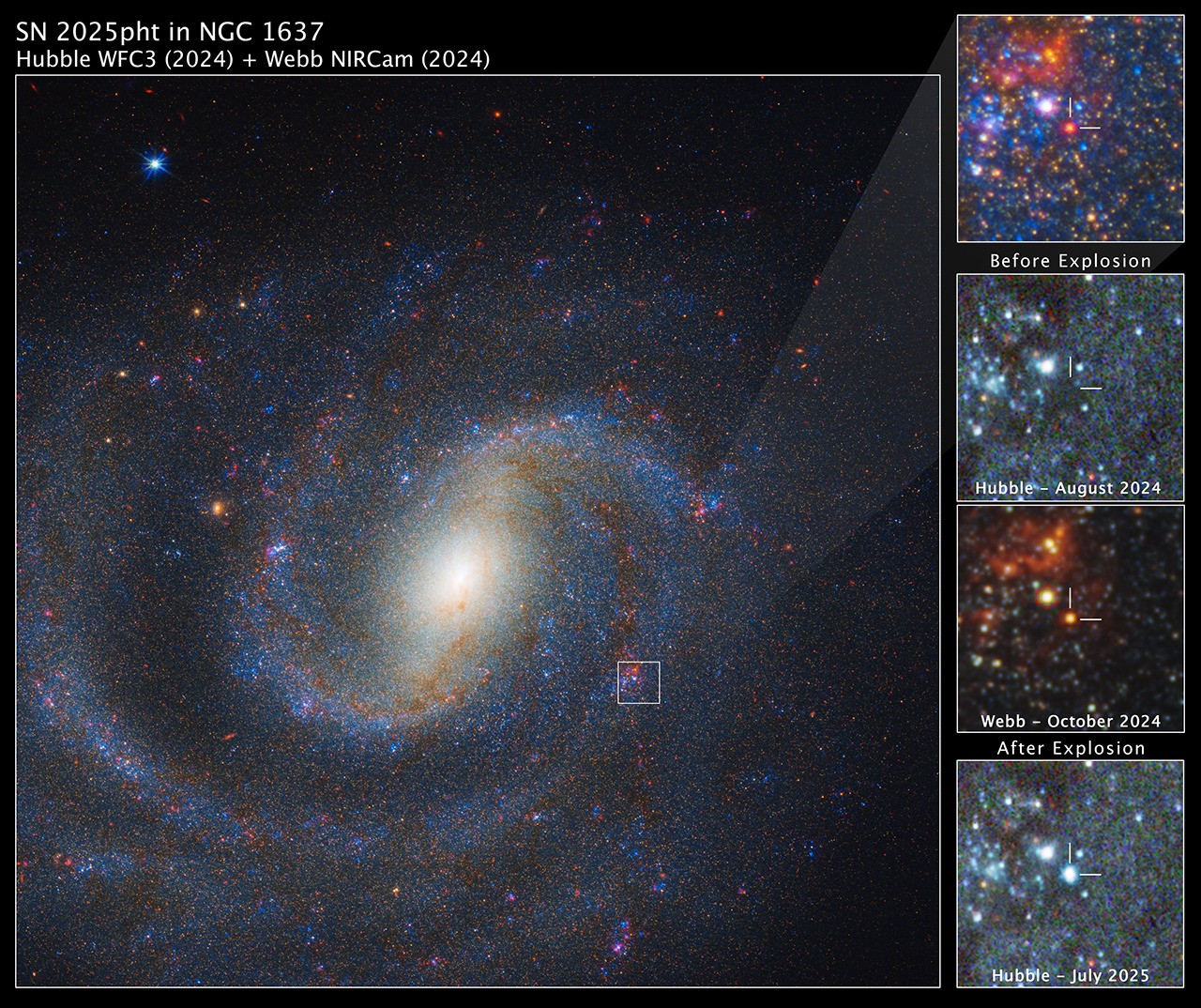
• NASA’s Webb Telescope Locates Former Star That Exploded as Supernova NASA Webb Mission Team Goddard Space Flight Center Contents Image: SN 2025pht in NGC 1637 Case of missing red supergiants Carbon “burps” Downloads & Related Information Related Links Forty million years ago, a star in a nearby galaxy exploded, spewing material across space and generating a brilliant beacon of light. • That light traveled across the cosmos, reaching Earth June 29, 2025, where it was detected by the All-Sky Automated Survey for Supernovae. • Astronomers immediately turned their resources to this new supernova, designated 2025pht, to learn more about it. • But one team of scientists instead turned to archives, seeking to use pre-supernova images to identify exactly which star among many had exploded. • Images of galaxy NGC 1637 taken by NASA’s James Webb Space Telescope showed a single red supergiant star located exactly where the supernova now shines. • This represents the first published detection of a supernova progenitor by Webb.
Article Summaries:
- NASA’s James Webb Space Telescope has, for the first time, identified the exact star that exploded as a supernova. The 2025pht event in galaxy NGC 1637 was traced back to a single red supergiant seen in Webb’s MIRI and NIRCam images taken in 2024. The star was unusually dusty, with a carbon‑rich envelope that dimmed its visible light, offering a possible explanation for the long‑standing “missing red supergiants” problem. The discovery, published in Astrophysical Journal Letters, combined Webb and Hubble data to fully characterize the progenitor and its pre‑explosion environment.
- NASA’s James Webb Space Telescope has, for the first time, pinpointed the exact star that exploded as supernova 2025pht in galaxy NGC 1637. By aligning Webb’s MIRI and NIRCam images with earlier Hubble data, researchers identified a single red supergiant at the supernova’s location. The star was unusually dusty and carbon‑rich, suggesting that massive stars may be heavily enshrouded in dust before collapse-an explanation for the long‑standing “missing red supergiants” problem. The discovery, published in Astrophysical Journal Letters, demonstrates Webb’s capability to study pre‑explosion stellar environments and informs future searches with the Roman Space Telescope.
Sources: