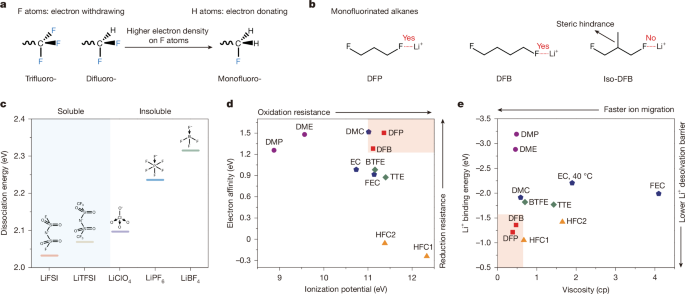
• Abstract Electrolyte solvents for electrochemical devices have been dominated by oxygen (O)-based and nitrogen (N)-based ligands over the past decades1,2,3,4,5, for which the dipole-ion (Li+, Na+ and so on) interaction usually lays the foundations of ion dissociation and transport but frustrates the charge transfer process at the electrolyte-electrode interface6,7,8,9 • Here, by synthesizing alkanes with monofluorinated structures, we show that fluorine (F)-based ligands with designed steric hindrance and Lewis basicity enable salt dissolution of more than 2 mol l−1 • Among them, 1,3-difluoro-propane (DFP)-based Li-ion electrolyte is endowed with all merits for energy-dense and low-temperature batteries, including low viscosity (0 • 95 cp), high oxidation stability (>4 • 9 V) and ionic conductivity of 0 • By incorporating F atoms in the first solvation shell, the weak F-Li+ coordination facilitates the Li plating/stripping process with Coulombic efficiency (CE) up to 99
Article Summaries:
- Abstract Electrolyte solvents for electrochemical devices have been dominated by oxygen (O)-based and nitrogen (N)-based ligands over the past decades1,2,3,4,5, for which the dipole-ion (Li+, Na+ and so on) interaction usually lays the foundations of ion dissociation and transport but frustrates the charge transfer process at the electrolyte-electrode interface6,7,8,9. Here, by synthesizing alkanes with monofluorinated structures, we show that fluorine (F)-based ligands with designed steric hindrance and Lewis basicity enable salt dissolution of more than 2 mol l−1. Among them, 1,3-difluoro-pr
Sources:
- https://www.nature.com/articles/s41586-026-10210-6 (Latest source article published: 2026-02-25 17:32 UTC)