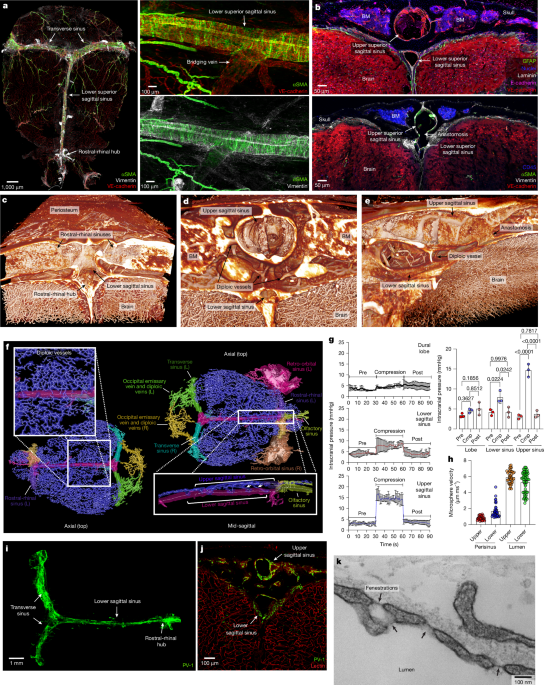
• Abstract The central nervous system is surrounded by three interconnected membranes referred to as the meninges, which host a diverse immune network1,2,3. • Within the skull-interfacing dura mater are venous sinuses, large veins that are traditionally viewed as passive blood drains for the brain and skull4,5. • However, these structures also constitute an important neuroimmune interface6,7,8. • Here we used intravital microscopy to gain mechanistic insight into this interface and reveal that dural sinuses and their endothelial cells form a highly dynamic surface that continually restructures to regulate blood flow, fluid movement and immune surveillance. • We show that sinuses are not passive conduits, but instead undergo RAMP1-dependent constriction and dilation mediated by smooth muscle, resembling arterial behaviour. • Moreover, the superior sagittal sinus in mice is bifurcated into upper and lower chambers that contribute to intracranial pressure regulation.
Sources: