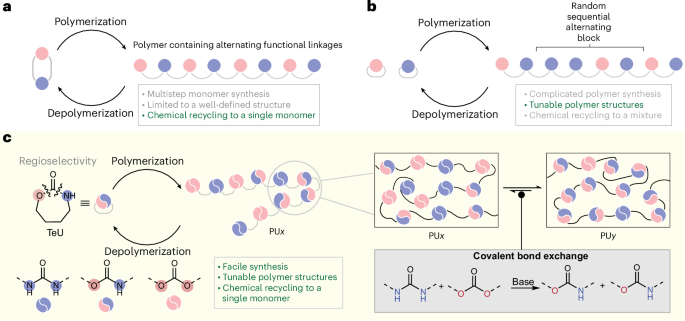
• Abstract The development of polymer products with a circular economy lifecycle represents a path to alleviate the growing plastic waste and energy crisis. • However, long-standing challenges include synthesis scalability, tunable material performance and the feasibility of chemical recycling from mixed products. • Here we developed a facile regioirregular polymerization strategy to access diverse polymer structures from a single monomer via regioselectivity and dynamic covalent bond exchange. • We were able to synthesize polyurethanes (PUx, where x represents the percentage of urethane linkages in the polymer) with tailored urethane contents by modulating the reaction time for the regioirregular polymerization of tetramethylene urethane. • The resulting PUx products showcase remarkable composition-dependent material performance, illustrating high strength, toughness and gas barriers comparable with commercial plastics. • In particular, PU57 exhibits superior adhesive strength, outperforming commercial glues.
Article Summaries:
- Researchers have introduced a regioirregular polymerization technique that generates a range of polyurethanes (PUx) from a single monomer, tetramethylene urethane. By adjusting reaction time, they control the proportion of urethane linkages, producing polymers with tunable properties. The resulting PUx materials exhibit high strength, toughness, and gas‑barrier performance comparable to commercial plastics, while PU57 shows superior adhesive strength to conventional glues. Importantly, all PUx variants can be chemically depolymerized back to the original monomer, demonstrating a closed‑loop “single monomer ↔ multiple polymers” system that could advance circular plastic economies.
Sources: