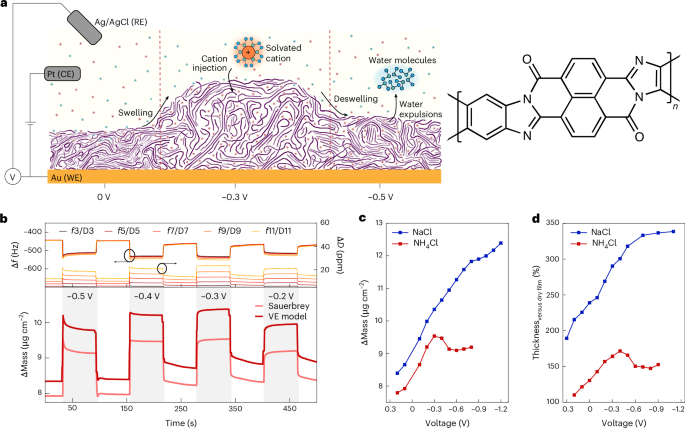
• Abstract Controlling ion-polymer interactions in organic mixed ionic-electronic conductors is crucial for optimizing device performance in applications ranging from bioelectronics and energy storage to photonics. • Achieving this requires a molecular-level understanding of how ion uptake, solvation and polymer structure evolve during electrochemical doping. • Here using a multimodal operando approach, we uncover an unexpected response in the prototypical n-type ladder polymer poly(benzimidazobenzophenanthroline) (BBL) on doping with protic cations such as ammonium. • At high doping levels, strong ion-polymer interactions (primarily hydrogen bonding) between cations and the BBL backbone promote charge localization and disrupt ion hydration, leading to a pronounced reduction in mass and thickness. • Operando 2H NMR identifies water expulsion, rather than ion removal, as the origin of this deswelling. • Our combined experimental and modelling results reveal a previously unobserved regime of ion-polymer coupling in organic mixed ionic-electronic conductors, establishing a framework for material design and applications that span (bio-)electronics to photonics.
Article Summaries:
- Researchers have uncovered a previously unknown mechanism in n‑type ladder polymer organic mixed ionic‑electronic conductors (OMIECs). Using a multimodal operando approach, they found that when the ladder polymer poly(benzimidazobenzophenanthroline) (BBL) is doped with protic cations such as ammonium, strong ion-polymer interactions-primarily hydrogen bonding-localize charge and disrupt ion hydration. This leads to water expulsion rather than ion removal, causing the polymer to deswell and reduce in mass and thickness. The study highlights a new regime of ion-polymer coupling, providing a framework for designing OMIECs for bioelectronics, energy storage, and photonics.
Sources: