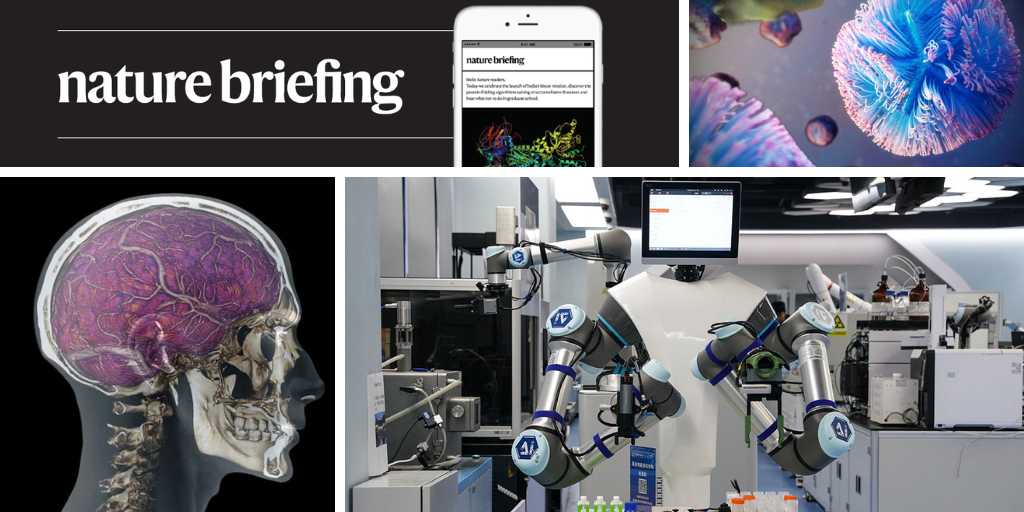
• Email Bluesky Facebook LinkedIn Reddit Whatsapp X You have full access to this article via your institution. • HelloNaturereaders, would you like to get this Briefing in your inbox free every day?Sign up here. • Chatbot-driven lab robots are automating methods such as protein synthesis.Credit: Du Yu/Xinhua via Alamy The automated lab robots are coming Small trials of autonomous laboratory systems made up of artificial-intelligence-controlled robot ‘scientists’ have sparked debate among researchers overthe extent to which such technology could replace humans. • These systems, which can automate simple tasks such as liquid transfer, are “going to be the future of biology”, says protein engineer Philip Romero. • But the technology currently struggles with tasks that require more dexterity, and might not be useful for experiments without a clear-cut measure of progress, say others. • Nature | 6 min read Reference:bioRxiv preprint(not peer reviewed) Virus co-opts protein-making equipment Scientists have identified a giant virus that can hijack a host cell’s protein-making machinery to churn out copies of itself - thefirst experimental evidence that viruses can co-opt this particular system, which is typically associated with cellular life.
Article Summaries:
- Automated laboratory robots-AI‑controlled “robot scientists” that can perform tasks such as liquid transfer-have entered small trials, prompting a debate among researchers about their future role in biology. Proponents, like protein engineer Philip Romero, argue that such systems will become the standard for routine lab work, while critics point out current limitations in dexterity and the difficulty of automating experiments that lack clear progress metrics. The discussion highlights the broader question of how far automation can replace human expertise in complex scientific workflows. The debate is ongoing, with further trials and studies needed to assess the technology’s practical impact.
Sources: