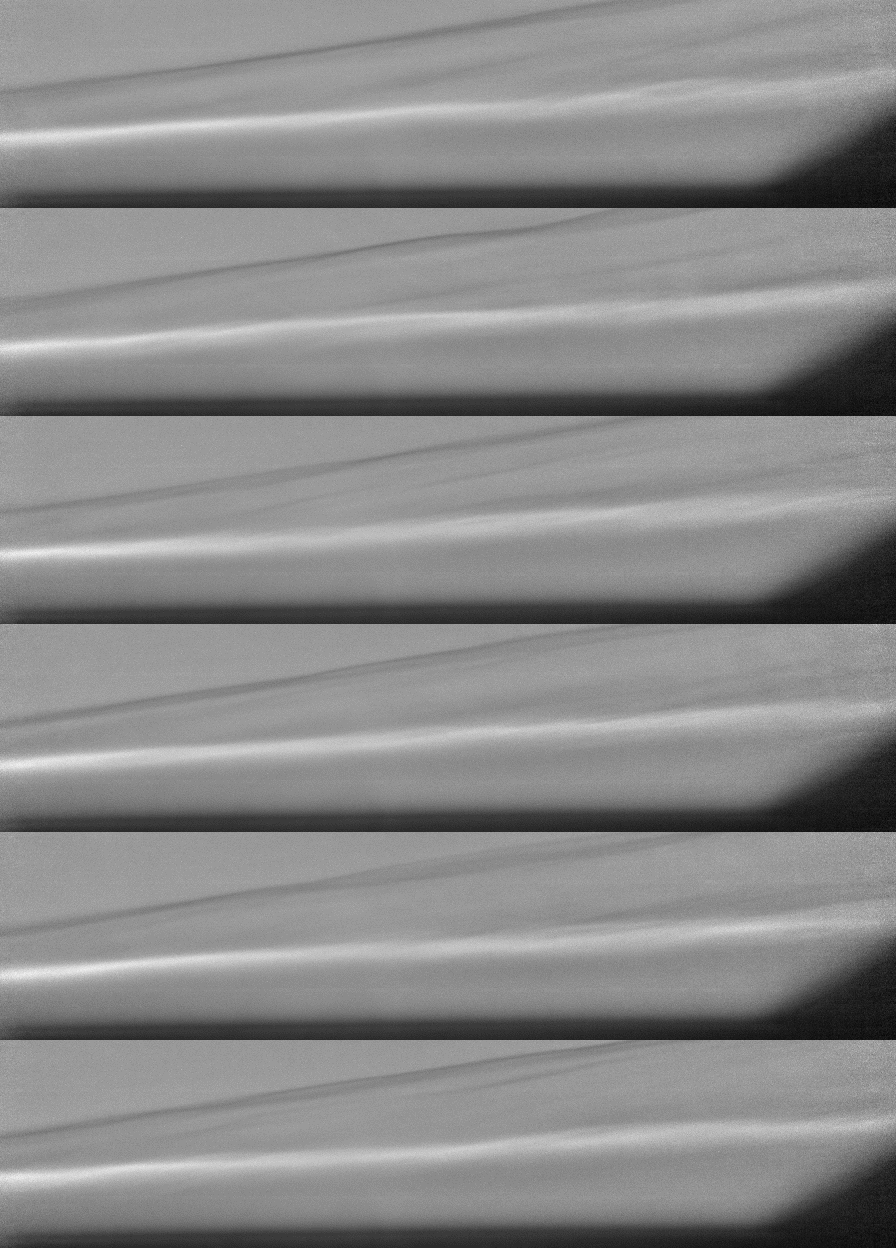
• Award-Winning NASA Camera Revolutionizes How We See the Invisible Diana Fitzgerald Writer Imagine trying to photograph wind. • That’s similar to what NASA engineers dealt with during a recent effort to study how air moves around planes, rockets, and other kinds of aerospace vehicles. • Air is invisible, but our understanding of how it flows is crucial for building better, safer aircraft. • For 80 years, researchers used a technique called “focused schlieren imaging.” Think of it as a special camera system that can “see” air movement by detecting tiny changes in its density. • It’s the same effect that lets you to see heat waves rising from hot pavement on a sunny day - just much more precise. • The Self-Aligned Focusing Schlieren (SAFS) system is a game-changer.
Article Summaries:
- NASA’s Langley Research Center has introduced the Self‑Aligned Focusing Schlieren (SAFS) system, a compact, low‑cost camera that visualizes invisible air flow around aircraft and rockets. Unlike traditional focused schlieren setups that require complex dual‑side alignment, SAFS uses light polarization to simplify installation and reduce downtime. The technology enables high‑speed flow‑visualization data in wind tunnels, aiding the design of safer, more efficient aircraft and spacecraft. Over 50 institutions in eight countries already use SAFS, and it has earned NASA’s 2025 Government Invention of the Year award and a spot on R&D World’s 2025 R&D 100 list.
- NASA’s Self‑Aligned Focusing Schlieren (SAFS) camera, a compact, low‑cost system that uses light polarization to simplify traditional focused schlieren imaging, has been adopted by more than 50 institutions worldwide. The technology allows researchers to capture high‑speed airflow around aircraft and rocket models with less setup time, lower facility downtime, and reduced costs. SAFS is already used in wind‑tunnel studies of commercial airliners and Space Launch System exhausts, improving predictions of take‑off, landing, and shock‑cell behavior. The system earned NASA the 2025 Government Invention of the Year award and a spot on R&D World’s 2025 R&D 100 Awards list.
Sources: