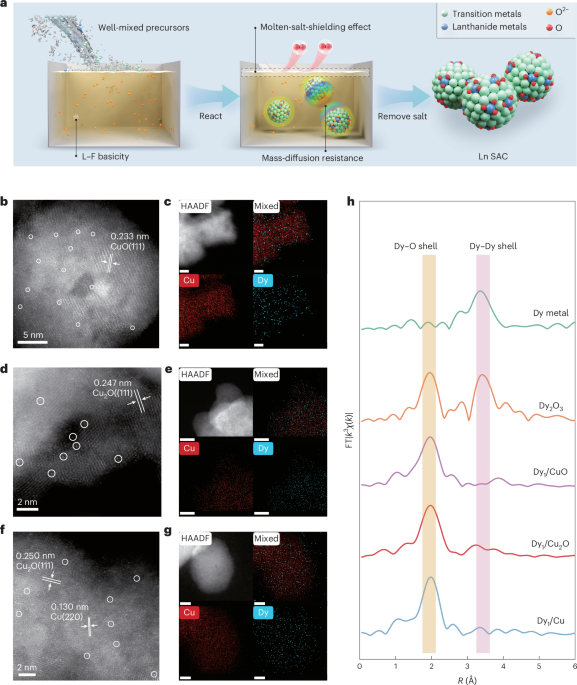
• Abstract Lanthanide (Ln) elements have distinctive electronic structures and chemical behaviours that can be used to tune electrocatalytic performance when they are introduced as isolated atomic modifiers. • However, their broader use remains limited because their high reactivity and ultralow reduction potentials make it difficult to develop general synthesis strategies that can atomically disperse Ln atoms on diverse substrates. • Here we develop a molten-nitrite method that yields Ln single-atom catalysts, permitting the atomic isolation of multiple lanthanides on various supports, including metals, metal oxides and carbon materials. • Mechanistic insights obtained from systematic control experiments indicate that Ln single-atom catalyst formation in molten nitrites is dictated by three factors: the Lux-Flood basicity effect, mass-diffusion resistance and molten-salt shielding. • As a demonstration, Dy1/Pt shows an overpotential of 20 mV at a current density of −10 mA cm−2 in 0.5-M H2SO4 for acidic hydrogen evolution, which is superior to commercial Pt/C catalysts. • This work establishes a framework for synthesizing Ln single-atom catalysts and positions molten-nitrite systems as a versatile platform for electrocatalyst synthesis.
Article Summaries:
- Researchers have developed a molten‑nitrite synthesis that atomically disperses lanthanide elements on a range of supports, including metals, oxides and carbon. The approach relies on three factors-Lux-Flood basicity, mass‑diffusion resistance and molten‑salt shielding-to stabilize isolated lanthanide atoms. As proof of concept, a single‑atom dysprosium on platinum (Dy1/Pt) delivers an overpotential of only 20 mV at -10 mA cm⁻² in 0.5 M H₂SO₄, outperforming commercial Pt/C for acidic hydrogen evolution. The study provides a general framework for creating lanthanide single‑atom catalysts and positions molten‑nitrite media as a versatile platform for electrocatalyst synthesis.
Sources: