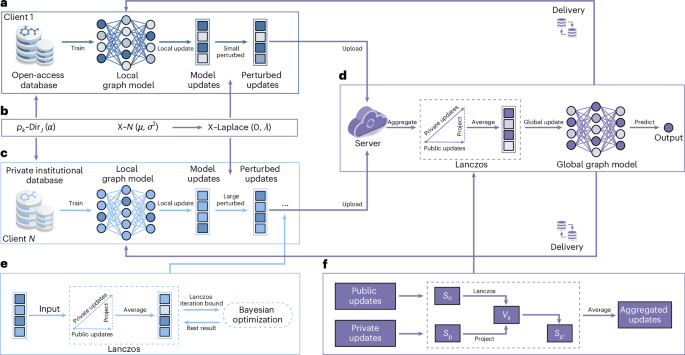
• Abstract Optimizing molecular resource utilization for molecular discovery requires collaborative efforts across research institutions and organizations to accelerate progress. • However, given the high research value of both successful and unsuccessful molecules produced by each institution (or organization), these findings are typically kept highly private and confidential until formal publication or commercialization, with even failed molecules rarely disclosed. • This confidentiality requirement presents a great challenge for most existing methods when collaboratively handling molecular data with heterogeneous distributions under stringent privacy constraints. • Here we propose FedLG (federated learning Lanczos graph), a federated graph learning method that leverages the Lanczos algorithm to facilitate collaborative model training across multiple parties, achieving reliable prediction performance under strict privacy protection conditions. • Compared with various existing federate learning methods, FedLG exhibits excellent model performance on 18 benchmark datasets in a simulated federated learning environment. • Under different privacy-preserving mechanism settings, FedLG demonstrates robust performance and resistance to noise.
Article Summaries:
- Abstract Optimizing molecular resource utilization for molecular discovery requires collaborative efforts across research institutions and organizations to accelerate progress. However, given the high research value of both successful and unsuccessful molecules produced by each institution (or organization), these findings are typically kept highly private and confidential until formal publication or commercialization, with even failed molecules rarely disclosed. This confidentiality requirement presents a great challenge for most existing methods when collaboratively handling molecular data w
Sources: