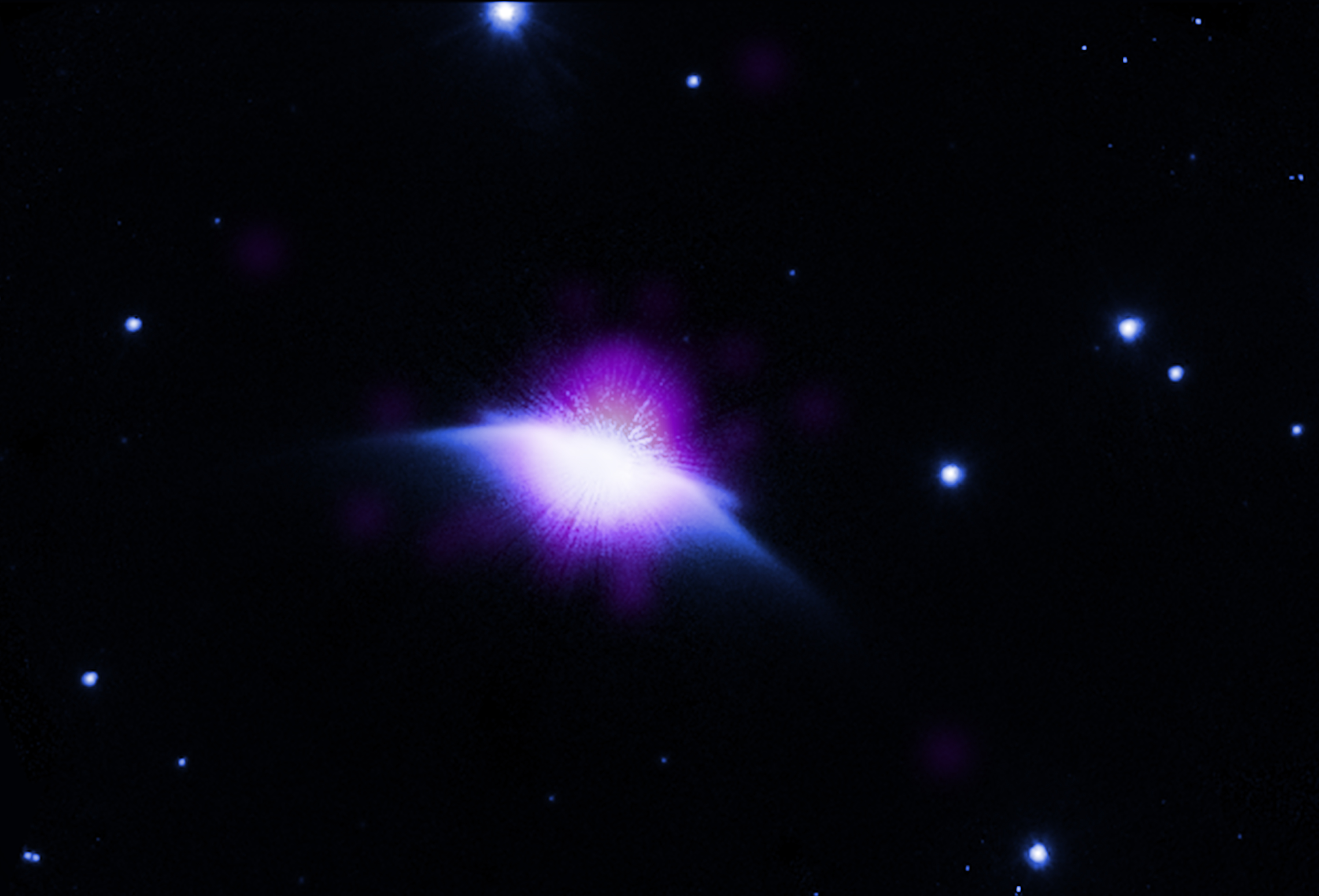
• Young ‘Sun’ Caught Blowing Bubbles by NASA’s Chandra Lee Mohon Contents Visual Description News Media Contact For the first time, a much younger version of the Sun has been caught red-handed blowing bubbles in the galaxy, by astronomers using NASA’s Chandra X-ray Observatory. • HD 61005 in X-ray, infrared, and optical light The bubble - called an “astrosphere” - completely surrounds the juvenile star. • Winds from the star’s surface are blowing up the bubble and filling it with hot gas as it expands into much cooler galactic gas and dust surrounding the star. • The Sun has a similar bubble around it, which scientists call the heliosphere, created by the solar wind. • It extends far beyond the planets in our solar system and protects Earth from cosmic radiation. • This is the first image of an astrosphere astronomers have obtained around a star similar to the Sun.
Article Summaries:
- NASA’s Chandra X‑ray Observatory has captured the first image of an “astrosphere” around a Sun‑like star. The 100‑million‑year‑old HD 61005, located about 120 light‑years from Earth, blows a powerful stellar wind that inflates a bubble of hot gas, similar to the heliosphere that surrounds our Sun. The bubble’s X‑ray glow, produced where the wind collides with dense interstellar dust and gas, reveals the star’s wind is roughly three times faster and 25 times denser than the Sun’s. This observation offers a glimpse of how the Sun’s own wind and protective bubble may have behaved early in its evolution.
- NASA’s Chandra X‑ray Observatory has, for the first time, captured an “astrosphere” - a bubble of hot gas blown by a star’s wind - around a young Sun‑like star, HD 61005, located about 120 light‑years away. The star, only ~100 million years old, emits a wind three times faster and 25 times denser than the Sun’s, creating a bubble roughly 200 times the Earth‑Sun distance. The image, published in the Astrophysical Journal, shows extended X‑ray emission rather than a point source, confirming that such bubbles can be observed around other stars. The discovery offers a direct view of how the Sun’s protective heliosphere may have looked in its early billions of years.
- NASA’s Chandra X‑ray Observatory has, for the first time, imaged a young star surrounded by a vast “astrosphere.” The bubble, created by powerful stellar winds, fills with hot gas as it expands into the cooler gas and dust of the surrounding galaxy. The observation mirrors the Sun’s heliosphere, which extends beyond the planets and shields Earth from interstellar particles. By capturing this early‑stage bubble, astronomers gain new insight into how young stars generate winds and shape their surrounding environment.
- NASA’s Chandra X‑ray Observatory has, for the first time, captured an “astrosphere” around a Sun‑like star. The 100‑million‑year‑old HD 61005, located 120 light‑years away, emits a powerful stellar wind that inflates a bubble of hot gas extending roughly 200 times the Earth‑Sun distance. The image, released in the Astrophysical Journal, shows extended X‑ray emission rather than a point source, confirming the presence of a heliosphere‑analogous bubble. Studying this young star’s wind-three times faster and 25 times denser than the Sun’s-offers insight into how the Sun’s own wind and protective bubble evolved over billions of years.
- For the first time, a much younger version of the Sun has been caught red-handed blowing bubbles in the galaxy, by astronomers using NASA’s Chandra X-ray Observatory. HD 61005 in X-ray, infrared, and optical light The bubble - called an “astrosphere” - completely surrounds the juvenile star. Winds from the star’s surface are blowing up the bubble and filling it with hot gas as it expands into much cooler galactic gas and dust surrounding the star. The Sun has a similar bubble around it, which scientists call the heliosphere, created by the solar wind. It extends far beyond the planets in our s
Sources:
- https://www.nasa.gov/missions/chandra/young-sun-caught-blowing-bubbles-by-nasas-chandra/
- https://phys.org/news/2026-02-young-sun-caught-chandra.html (Latest source article published: 2026-02-23 20:40 UTC)