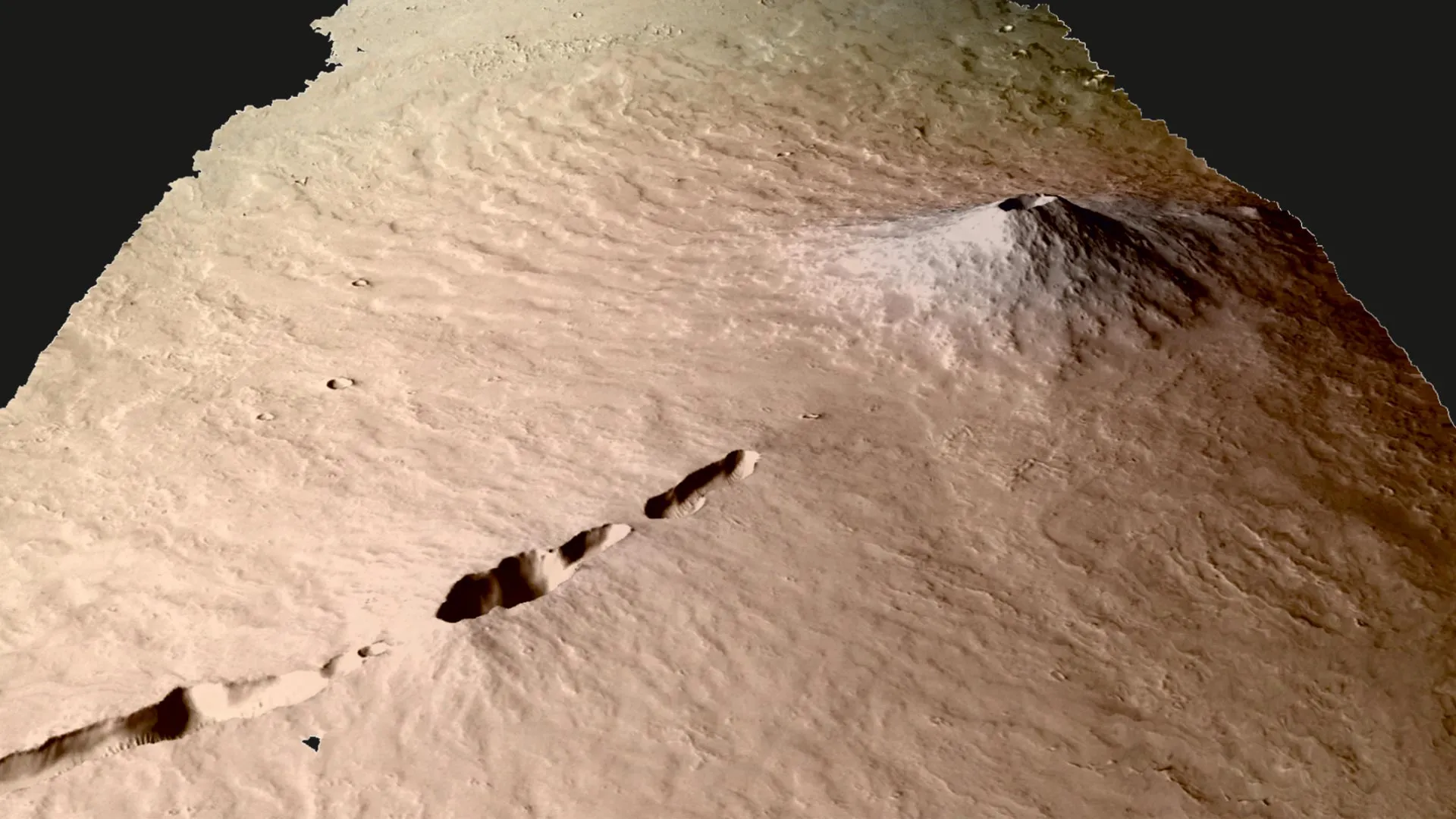
• Young Mars volcano hides a powerful magma engine beneath the surface Volcanic eruptions that look like single events are often the visible outcome of slow, complicated activity taking place deep underground. • Beneath the surface, magma shifts position, changes chemically, and can sit for long stretches before finally erupting. • To piece together what is happening below, scientists examine lava flows, rock textures, and minerals left behind at the surface. • These clues help reveal the hidden magma systems that drive volcanic activity. • A recent study published inGeologyshows that this same complexity exists on Mars. • High resolution images of the landscape and mineral measurements collected from orbit indicate that some of the planet’s youngest volcanic regions have a much more detailed history than previously assumed.
Article Summaries:
- Summary
A 2026 study by an international team (Adam Mickiewicz University, University of Iowa, Lancaster Environment Centre) used high‑resolution orbital imagery and mineral spectroscopy to re‑examine a young Martian volcano south of Pavonis Mons. The data reveal that the volcano did not erupt in a single event; instead, it formed through multiple eruptive phases driven by a single, evolving magma reservoir beneath the surface. Mineral fingerprints indicate changes in magma composition, depth, and storage time across these phases, suggesting a long‑lived, complex subsurface system. The findings imply that Mars’ interior was more volcanically active in its recent past than previously thought.
- Young Mars volcano hides a powerful magma engine beneath the surface - Date: - February 23, 2026 - Source: - Geological Society of America - Summary: - A Martian volcano once thought to be the result of a single eruption turns out to have a much more complex past. Orbital imaging and mineral data show it developed through multiple eruptive phases, all powered by the same evolving magma system underground. Shifts in mineral composition reveal the magma changed over time, hinting at different depths and storage histories. Marsâ interior was far more active than previously believed. - Share: Volc
Sources:
- https://www.sciencedaily.com/releases/2026/02/260222092329.htm (Latest source article published: 2026-02-23 06:19 UTC)