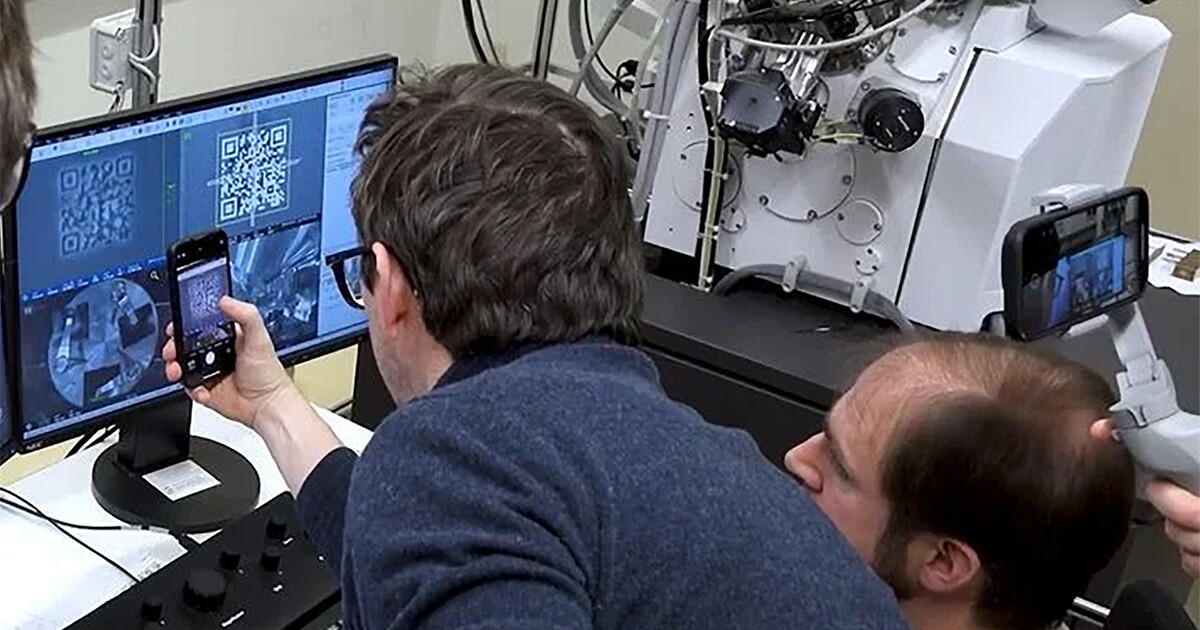
• Record-breaking microscopic QR code battle built to store our future Facebook Twitter LinkedIn Reddit Flipboard Email For those of us who weren’t paying attention, over the last few years, scientists around the world have been one-upping each other in a bid to create the smallest QR code that can be reliably read. • Now, Austria-based researchers have set the bar real high with a QR code so tiny, you’ll need an electron microscope to see it. • Material scientists from the TU Wien public research university in Vienna have shrunk the specialized barcode down to an area of 1.98 square micrometers, which is smaller than many bacteria, and is invisible to optical microscopes. • It’s officiallyearned the team a place in the Guinness World Records. • “Structures on the micrometer scale are nothing unusual today - it is even possible to fabricate patterns made of individual atoms,” said Professor Paul Mayrhofer from TU Wien’s Institute of Materials Science and Technology. • “However, that alone does not result in a stable, readable code.” Indeed,the previous record for the smallest QR codewasset by a Germany-based team at the University of Münster, fitting a pattern into an area of just 5.38 square micrometers - many times smaller than a human red blood cell.
Article Summaries:
- Researchers at TU Wien have created the world’s smallest QR code, measuring just 1.98 µm²-smaller than many bacteria-and earned a Guinness World Record. The code, etched onto a thin ceramic film in collaboration with German startup Cerabyte, uses 49‑nm pixels, which are ten times smaller than visible‑light wavelengths and can only be read with an electron microscope. This marks a significant improvement over the previous 5.38 µm² record set by a German team. The ceramic medium promises long‑term stability, with a single A4 sheet potentially holding over 2 TB of data. Researchers plan to explore other data formats and materials for durable, energy‑efficient storage.
Sources: