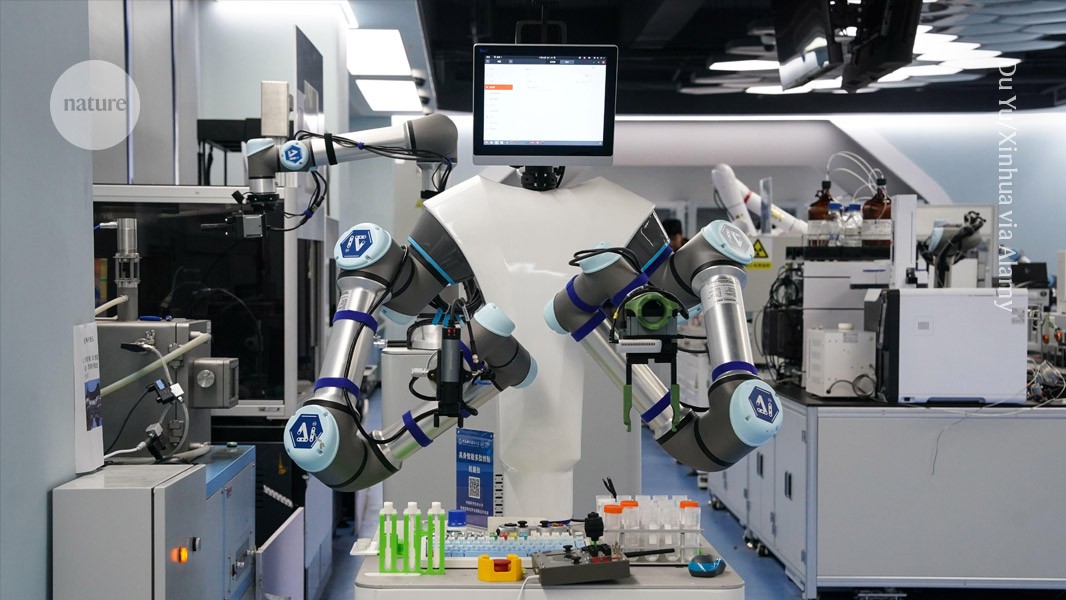
• Email Bluesky Facebook LinkedIn Reddit Whatsapp X Chatbot-driven lab robots are automating methods like protein synthesis.Credit: Du Yu/Xinhua via Alamy Last year, synthetic biologist Meagan Olsen performed the biggest experimental campaign of her career. • The PhD student at Northwestern University in Evanston, Illinois, was trying to make proteins in a test tube more efficiently. • Across more than 40 experiments over 4 months, she tested 1,231 combinations of sugars, amino acids and other ingredients, including cellular machinery, before landing on a cocktail that was at least six-times cheaper than existing cell-free protein synthesis recipes1. • Now, an ‘autonomous laboratory’ system made up of a large language model (LLM) ‘scientist’, lab robotics that automate simple tasks such as liquid transfer and human overseers created by scientists at artificial-intelligence firm OpenAI in San Francisco, California, and Ginkgo Bioworks, a biotechnology company in Cambridge, Massachusetts, has eclipsed Olsen’s record. • It achieved a further 40% reduction in cost, after testing more than 30,000 experimental conditions over 6 months2. • The findings - described in a paper posted on the bioRxiv preprint server on 5 February - have sparked discussion over the extent to which chatbot-controlled robots could replace humans.
Article Summaries:
- Thank you for visiting nature.com. You are using a browser version with limited support for CSS. To obtain the best experience, we recommend you use a more up to date browser (or turn off compatibility mode in Internet Explorer). In the meantime, to ensure continued support, we are displaying the site without styles and JavaScript. Last year, synthetic biologist Meagan Olsen performed the biggest experimental campaign of her career. The PhD student at Northwestern University in Evanston, Illinois, was trying to make proteins in a test tube more efficiently. Across more than 40 experiments over
Sources: