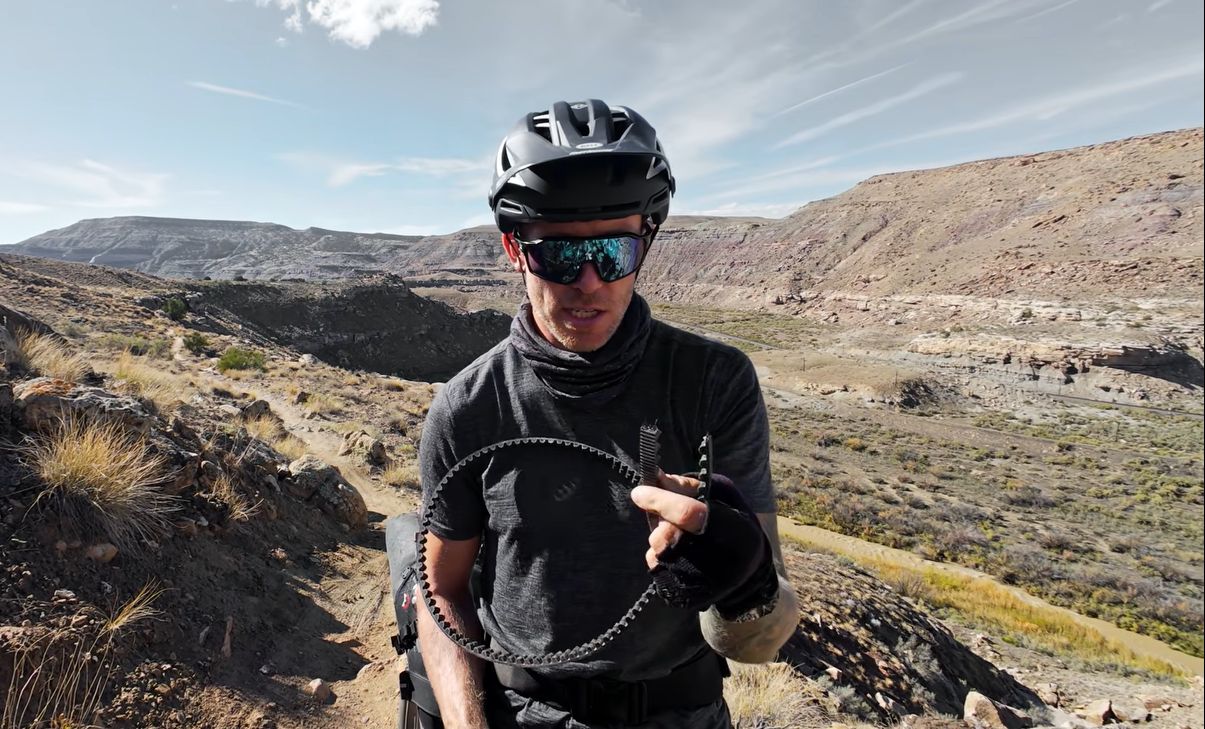
• Theoretically a belt drive makes for a great upgrade to a bicycle, as it replaces the heavier, noisy and relatively maintenance-heavy roller chain with a zero-maintenance, whisper-quiet and extremely reliable belt that’s rated at an amazing 20-30,000 km before needing a replacement. • Of course, that’s the glossy marketing brochure version of reality, which differed significantly from what [Tristan Ridley] experienced whilst cycling around the globe. • Although initially he was rather happy with his bike, its sealed car-like Pinion gearbox and Gates carbon belt drive system, while out in the wilds of Utah he had a breakdown when the belt snapped. • When the spare belt that he had carried with him for the past months also snapped minutes later after fitting it on, it made him decide to switch back to the traditional bush roller chain. • Despite this type of chain drive tracing its roots all the way back to Leonardo da Vinci, they actually offer many advantages over the fancy carbon-fiber-reinforced polyurethane belt. • Although with the Pinion gearbox the inability to use a derailleur gearing system is no big deal, [Tristan] found that the ‘zero maintenance’ part of the belt was not true for less hospitable roads A big issue was that of abrasive dust, which created a very noisy coating on the belt that’d have to be regularly cleaned off with precious water, or by having silicone lubricant sprayed on the belt.
Article Summaries:
- Tristan Ridley’s global rides reveal that bicycle belt drives, marketed as low‑maintenance, quiet alternatives to chains, often fail in real‑world conditions. While a Pinion gearbox and Gates carbon‑fiber belt promise 20‑30 000 km of use, Ridley experienced multiple belt breaks in Utah, especially after storage that compromised the fibers. Dust and mud quickly degrade belt performance, requiring frequent cleaning and leading to premature failure after roughly 8 000 km. In contrast, traditional roller chains withstand abrasive environments, are easily repaired on the go, and can be stored compactly. Ridley concludes belts are suitable only for smooth city roads, whereas chains remain the more reliable choice for varied terrain.
Sources: