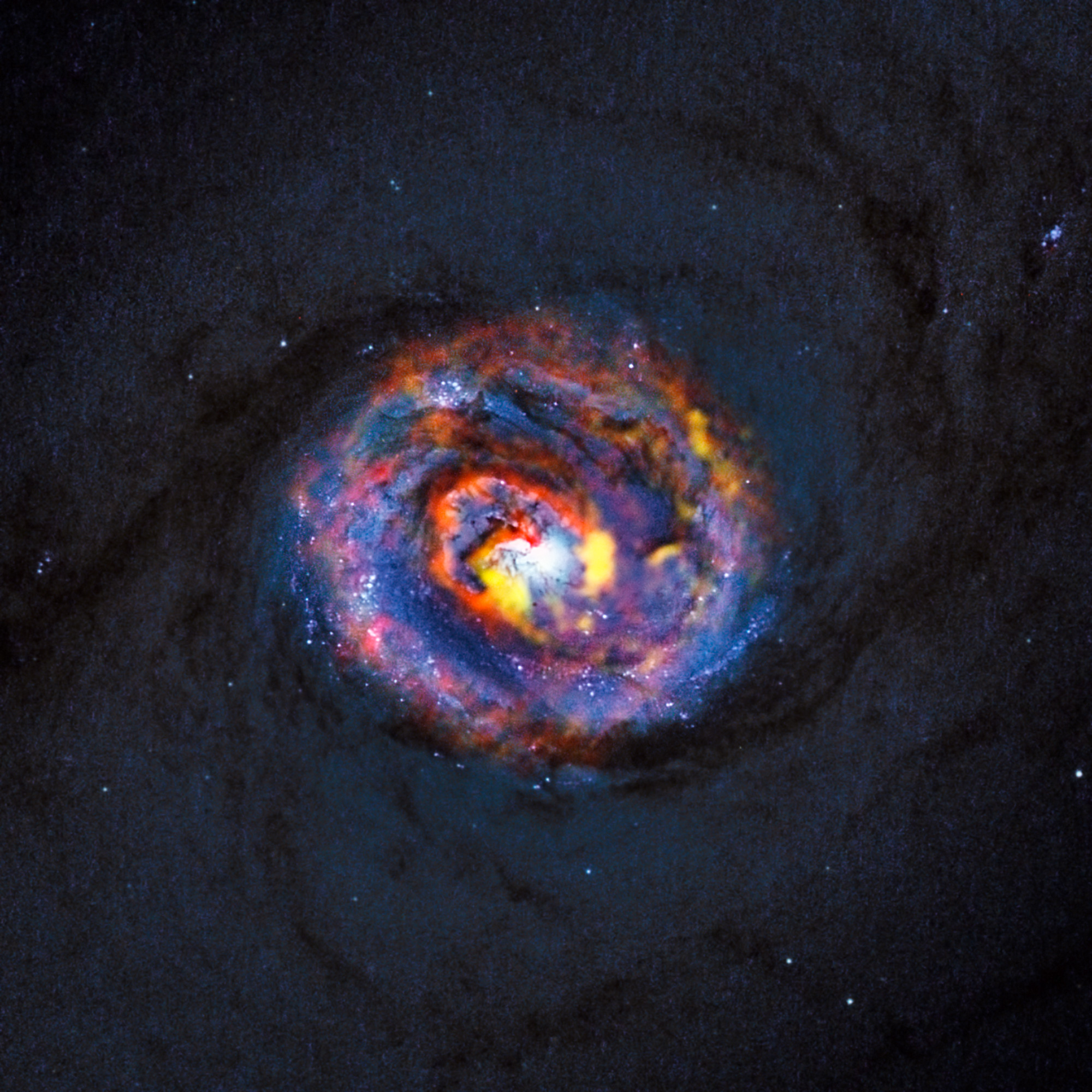
• Where have all the AGN gone? • byMargaret Verrico| Feb 10, 2026 |Daily Paper Summaries|0 comments Title:No evidence for excess AGN activity in recently quenched massive galaxies at cosmic noon Authors:Omar Almaini, Vivienne Wild, David Maltby, Elizabeth Taylor, Kate Rowlands, Thomas de Lisle, Katherine Alatalo, Jimi Harrold, Guillaume Hewitt, Pallavi Patil, Maya Skarbinski First Author’s Institution:School of Physics and Astronomy, University of Nottingham, University Park, Nottingham NG7 2RD, UK Status:Published in Monthly Notices of the Royal Astronomical Society [openaccess] Background Many nearby galaxies fall into two broad populations: star-formingspiral galaxieslike the Milky Way or massive “passive"elliptical galaxieswhich have long since stopped forming stars. • We think most of these passive galaxies shut down their star formation 7-11 billion years ago in the period called “Cosmic Noon,” the era of peak star formation in the Universe. • How these galaxies stopped forming stars is still a primary question in galaxy evolution. • One theory for shutting down or “quenching” star formation is feedback fromactive galactic nuclei, or AGN. • AGN aresupermassive black holeaccretion systems at the centers of massive galaxies.
Article Summaries:
- A new study published in Monthly Notices of the Royal Astronomical Society reports no excess of active galactic nuclei (AGN) in massive galaxies that have recently ceased star formation during the Universe’s “Cosmic Noon” epoch. Using Principal Component Analysis to classify galaxies and spectral energy distribution fitting to estimate masses and star‑formation rates, the authors cross‑matched a large sample of post‑starburst galaxies with Chandra X‑ray observations. While individual luminous AGN were identified, stacking of undetected X‑ray images revealed no significant AGN signal above the background. The results suggest that AGN feedback may not be the dominant mechanism driving the rapid quenching of star formation in these galaxies.
Sources: