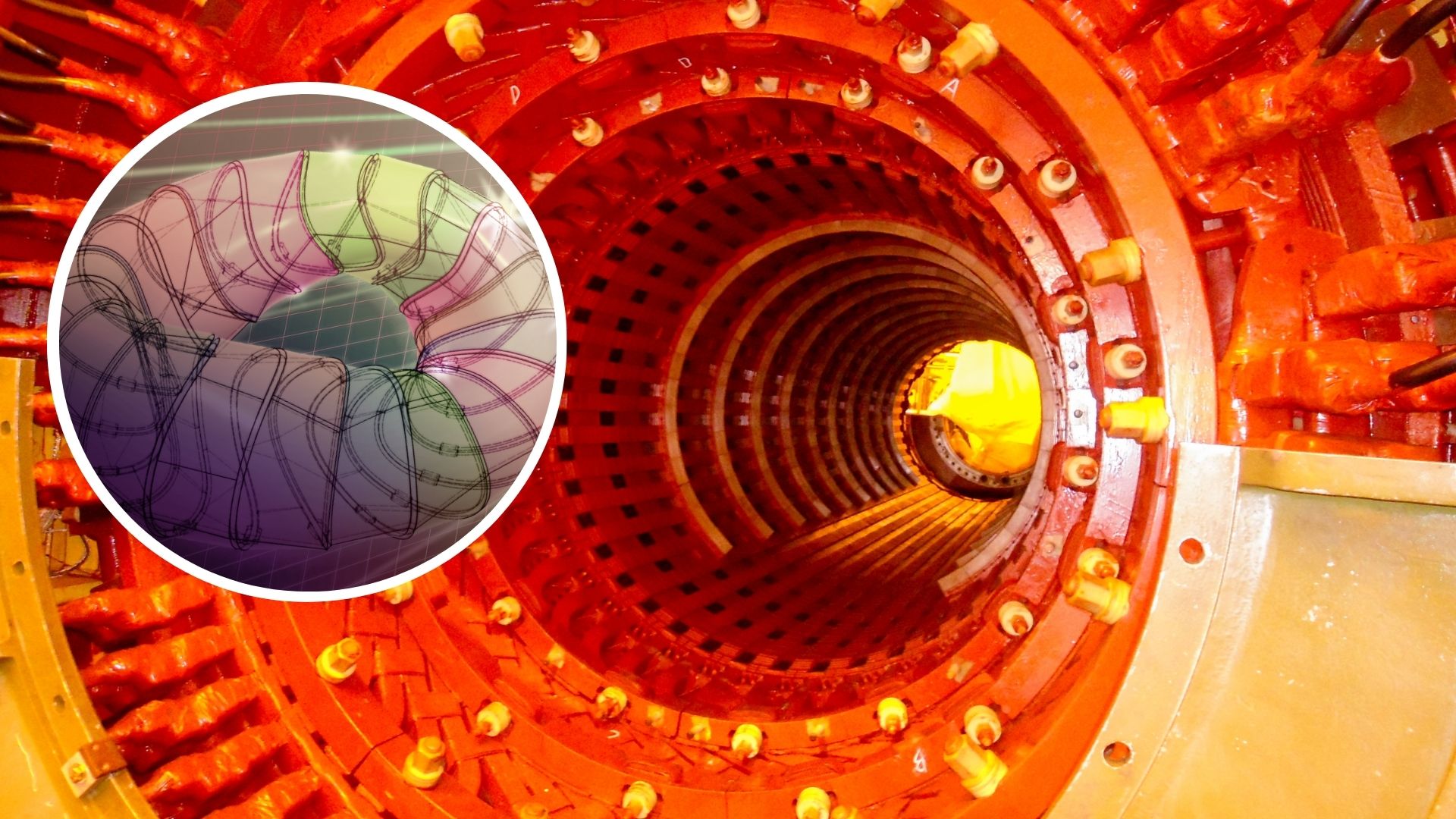
• US to rapidly design fusion stellarators using AI, could test configurations in seconds The StellFoundry project allows scientists to test thousands of fusion designs in record time. • The United States is set to accelerate the design of stellarator devices for fusion energy projects. • The Department of Energy’s Princeton Plasma Physics Laboratory plans to use AI to fast-track these complex, twisty fusion facilities. • Stellarators use magnets with complicated shapes circling the outside of the system’s vacuum vessel to create all the magnetic fields needed to confine the fusion plasma. • Known as StellFoundry, the new project focuses on replacing lengthy calculations in the design process with types of digital models, or surrogates, that provide rough calculation estimates. • Fast approximations test large number of stellarator configurations quickly These fast approximations allow scientists to quickly test a large number of possible stellarator configurations more quickly than if they used calculations that were more precise but needed more time to perform.
Article Summaries:
- The U.S. Department of Energy’s Princeton Plasma Physics Laboratory (PPPL) has launched the StellFoundry project to accelerate the design of stellarator fusion devices using artificial intelligence. By replacing lengthy physics calculations with surrogate digital models, StellFoundry can evaluate thousands of stellarator configurations in seconds instead of hours or days. The initiative, involving about 30 researchers from universities, software firms, and national labs, also enables different simulation codes to interoperate, producing more comprehensive device models quickly. StellFoundry aligns with the DOE’s Genesis Mission and Fusion Science and Technology Roadmap, aiming to speed the development of commercially viable fusion energy by the 2030s.
Sources: