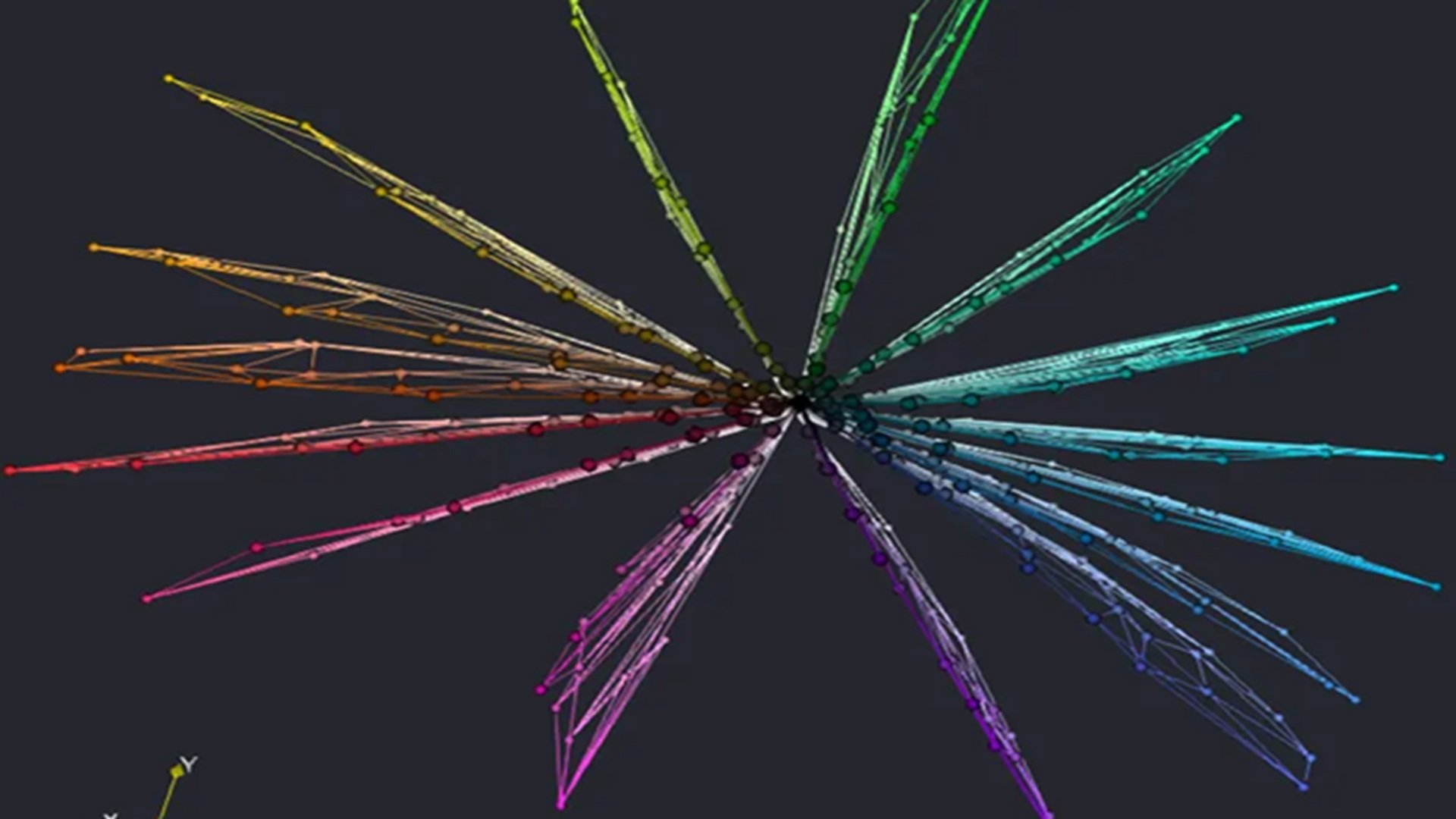
• US scientists solve Schrödinger’s 100-year-old theory of human color perception The team used geometry to define a crucial missing element known as the neutral axis • Researchers in the US have finally completed the missing mathematical pieces of theoretical physicist Erwin Schrödinger’s century-old color theory, based on his geometric model describing how humans perceive color • In the 1920s, the Austrian-Irish scientist proposed a mathematical model of color perception based on visual response • He suggested that the full range of human-visible colors could be mapped as a three-dimensional geometric shape defined by cone-cell responses • Now, a team of researchers led by Roxana Bujack, PhD, a computer scientist at Los Alamos National Laboratory (LANL), used advanced geometry to show that saturation, hue, and lightness aren’t shaped by culture or experience • The scientists finalized Schrödinger’s model and showed that these attributes are built directly into the mathematical structure of human vision, and not just “in the eye of the beholder
Article Summaries:
- US scientists solve Schrödinger’s 100-year-old theory of human color perception The team used geometry to define a crucial missing element known as the neutral axis. Researchers in the US have finally completed the missing mathematical pieces of theoretical physicist Erwin Schrödinger’s century-old color theory, based on his geometric model describing how humans perceive color. In the 1920s, the Austrian-Irish scientist proposed a mathematical model of color perception based on visual response. He suggested that the full range of human-visible colors could be mapped as a three-dimensional geom
Sources:
- https://interestingengineering.com/science/schrodinger-color-theory-completed (Latest source article published: 2026-02-25 13:38 UTC)