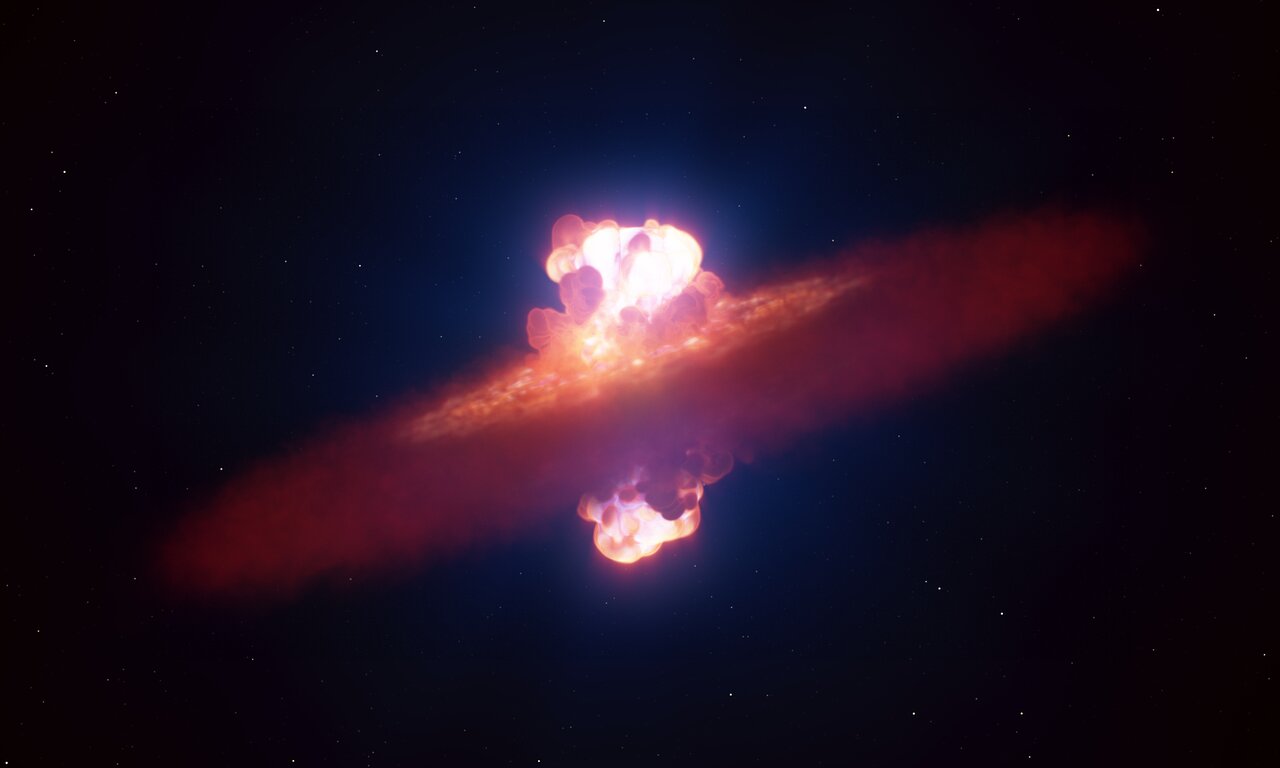
• Press Release Unique shape of star’s explosion revealed just a day after detection 12 November 2025 Swift observations with the European Southern Observatory’s Very Large Telescope (ESO’s VLT) have revealed the explosive death of a star just as the blast was breaking through the star’s surface. • For the first time, astronomers unveiled the shape of the explosion at its earliest, fleeting stage. • This brief initial phase wouldn’t have been observable a day later and helps address a whole set of questions about how massive stars go supernova. • When the supernova explosion SN 2024ggi was first detected on the night of 10 April 2024 local time, Yi Yang, an assistant professor at Tsinghua University in Beijing, China, and the lead author of the new study, had just landed in San Francisco after a long-haul flight. • He knew he had to act quickly. • Twelve hours later, he had sent an observing proposal to ESO, which, after a very quick approval process, pointed its VLT telescope in Chile at the supernova on 11 April, just 26 hours after the initial detection.
Article Summaries:
- Astronomers captured the shape of a supernova’s shock‑breakout phase just 26 hours after the explosion of SN 2024ggi was first detected. Using the European Southern Observatory’s Very Large Telescope in Chile, a team led by Yi Yang of Tsinghua University performed spectropolarimetric observations that revealed the geometry of the blast as it emerged from the surface of a red supergiant in NGC 3621, 22 million light‑years away. This is the first time the earliest, fleeting shape of a massive‑star supernova has been directly observed, offering new insights into the mechanisms that drive such stellar deaths.
Sources: