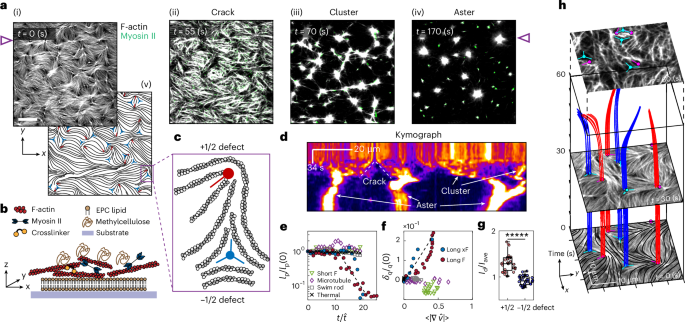
• Abstract Active solids using energy influx to generate non-equilibrium forces undergo spontaneous mechanical failure, but how topological defects concentrate internal stresses and control breakage in active materials is unknown • Here we assemble a reconstituted two-dimensional actomyosin network that lacks fluidity but exhibits nematic order and network elasticity • Surprisingly, we found that interacting multidefect configurations, especially defect quadrupoles with two +1/2 and two −1/2 defects, play a crucial role • Combining experimental data with an active solid fracture model, we demonstrate that a head quadrupole with mutually facing +1/2 defects can trigger crack opening and material tearing • Meanwhile, tail quadrupoles with mutually opposing +1/2 defects drive transient filament clustering and condenses into asters • We establish a deep learning model to predict the eventual aster formation from the initial topological structures
Article Summaries:
- Abstract Active solids using energy influx to generate non-equilibrium forces undergo spontaneous mechanical failure, but how topological defects concentrate internal stresses and control breakage in active materials is unknown. Here we assemble a reconstituted two-dimensional actomyosin network that lacks fluidity but exhibits nematic order and network elasticity. Surprisingly, we found that interacting multidefect configurations, especially defect quadrupoles with two +1/2 and two −1/2 defects, play a crucial role. Combining experimental data with an active solid fracture model, we demonstra
Sources:
- https://www.nature.com/articles/s41563-026-02493-x (Latest source article published: 2026-02-26 07:32 UTC)