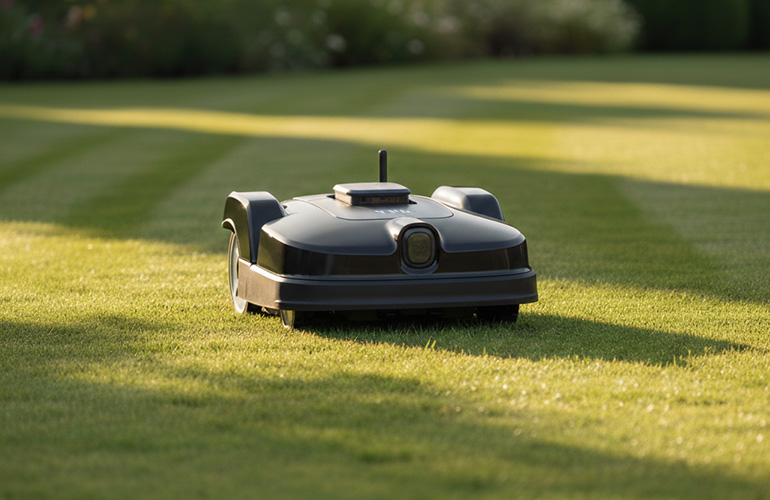
• The era of burying perimeter wires is over. • As the industry shifts to RTK GPS, virtual boundaries are replacing physical ones. • | Credit: RTKData The robotic lawn mower market is undergoing a fundamental transition. • For years, perimeter wires defined the operating boundaries for autonomous mowers, requiring homeowners to bury low-voltage cables around their property. • They complicate landscaping changes. • Installation takes hours.
Article Summaries:
- The robotic lawn mower market is shifting from perimeter wires to RTK GPS, eliminating physical cables but creating a new dependency on continuous GNSS correction data. RTK achieves centimeter‑level accuracy by streaming corrections via NTRIP, a protocol that requires a robust caster to handle thousands of concurrent connections with low latency. Building this infrastructure in-house forces OEMs to divert engineering resources from robotics to distributed systems. Services like RTKdata.com offer managed NTRIP casters, routing corrections globally and scaling effortlessly. By outsourcing the correction layer, OEMs can focus on product differentiation while ensuring reliable, high‑precision operation for large fleets.
- The robotic lawn mower market is shifting from perimeter wires to RTK GPS, enabling centimeter‑level precision without buried cables. This change improves customer experience but creates a new dependency: continuous GNSS correction data delivered via NTRIP. For fleets of thousands of robots, an NTRIP caster must handle high‑concurrency, low‑latency connections and geographic load balancing-an engineering challenge beyond most OEMs’ core expertise. Services such as RTKdata.com offer a managed NTRIP layer, routing correction streams to robots worldwide. By outsourcing this infrastructure, OEMs can focus on robot design and accelerate market entry while ensuring reliable, scalable positioning.
- Robotic lawn mowers are moving from perimeter‑wire boundaries to RTK GPS navigation, which offers centimeter‑level accuracy without buried cables. This shift improves customer experience but creates a new dependency: continuous GNSS correction data delivered via NTRIP. For fleets of thousands of robots, the required NTRIP caster must support high‑concurrency, low‑latency connections and robust fail‑over, demanding significant engineering resources. OEMs face a build‑versus‑buy decision. Services such as RTKdata.com provide managed NTRIP infrastructure, allowing manufacturers to focus on robot design while outsourcing the complex correction‑stream routing.
- The robotic lawn mower market is shifting from perimeter wires to real‑time kinematic (RTK) GPS, eliminating the need for buried cables but creating a new dependency on continuous GNSS correction data. RTK achieves centimeter‑level accuracy by streaming corrections via NTRIP, a protocol that requires a robust caster capable of handling thousands of concurrent, low‑latency connections and geographic load balancing. Building this infrastructure in‑house forces OEMs to divert engineering resources from robot design. Services such as RTKdata.com offer a managed NTRIP caster, routing corrections to fleets of any size with minimal integration effort. By outsourcing the correction layer, OEMs can focus on product differentiation while ensuring reliable, scalable positioning.
Sources:
- https://www.therobotreport.com/the-hidden-infrastructure-challenge-facing-outdoor-robotics-oems/ (Latest source article published: 2026-02-23 20:46 UTC)