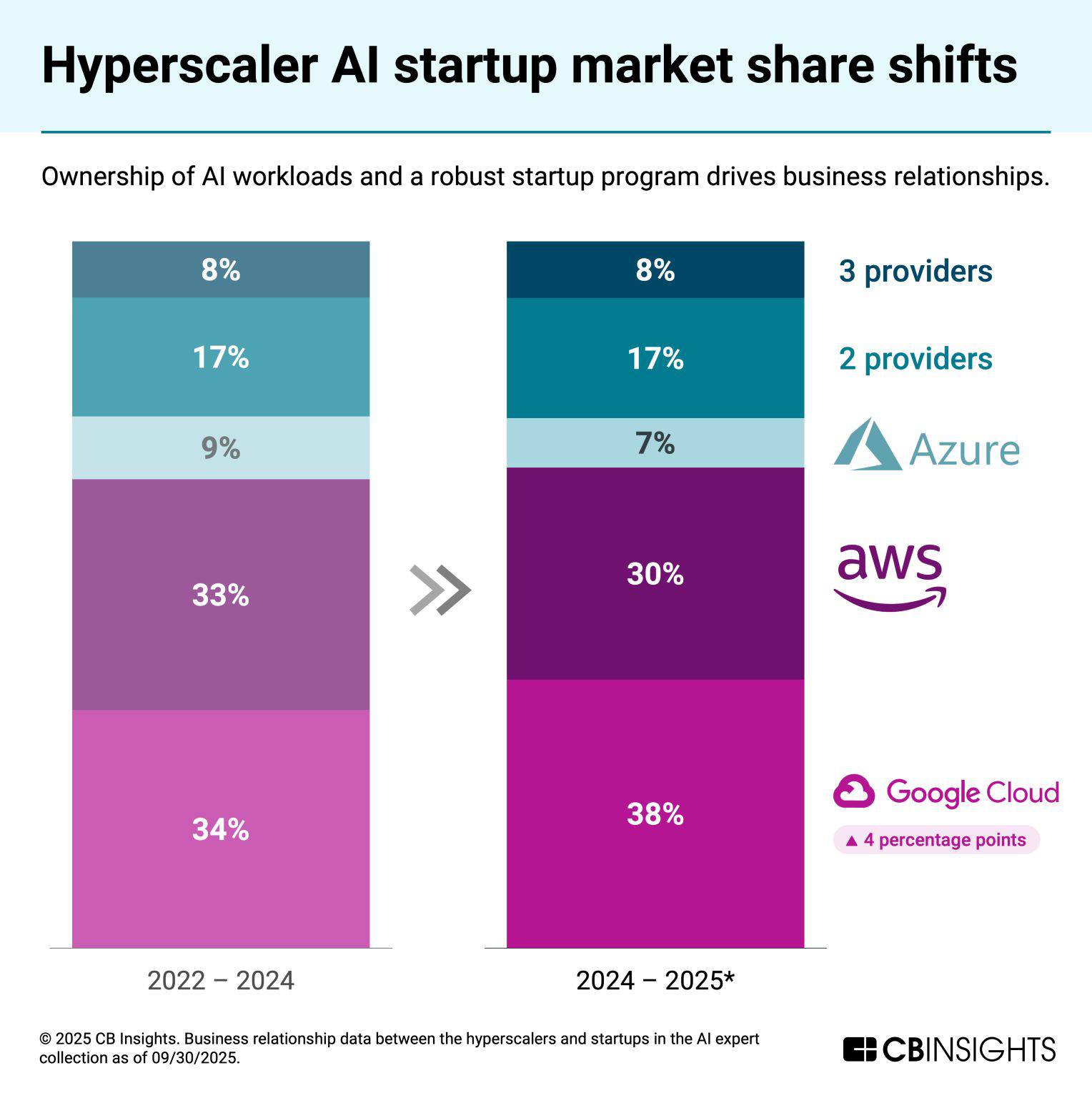
• A subtle shift is taking place in how cloud providers win usage among AI startups. • For years, competition focused on compute availability, enterprise relationships, and pricing. • But as AI teams increasingly begin with model experimentation and development tools, the AI stack they choose first is shaping where they run and scale their workloads. • At the same time, GPU scarcity, evolving model ecosystems, and hyperscalers’ differing approaches - from integrated AI stacks to model neutrality to enterprise partnerships - are reshaping how startups make cloud decisions. • These shifts raise questions about what’s driving cloud adoption among AI builders today, and where providers are gaining (or losing) traction. • Key Takeaways: Google’sAI-native stack is converting early experimentation into long-term cloud usage: Google’s integrated Gemini ecosystem - spanning Google AI Studio, Vertex, and its expanding infrastructure footprint throughCipher Mining- is pulling AI teams into GCP earlier in their workflow.
Article Summaries:
- Cloud competition is shifting from raw compute to the AI stack that startups use first. Google’s integrated Gemini ecosystem is pulling teams into GCP early, boosting its backlog by 46 % to $155 bn in Q3 ‘25 and raising its market share to 38 %. AWS maintains a neutral stance-no proprietary LLM-attracting founders who want broad compute, large credit packages, and model interoperability, even as its share falls to 30 %. Azure’s enterprise‑first partnerships with OpenAI and Anthropic have not translated into stronger startup traction. GPU scarcity is forcing roughly 25 % of AI startups to adopt multi‑cloud for capacity, a trend likely to grow. All three hyperscalers are hiring aggressively for startup and VC partnership teams to win new business.
Sources: