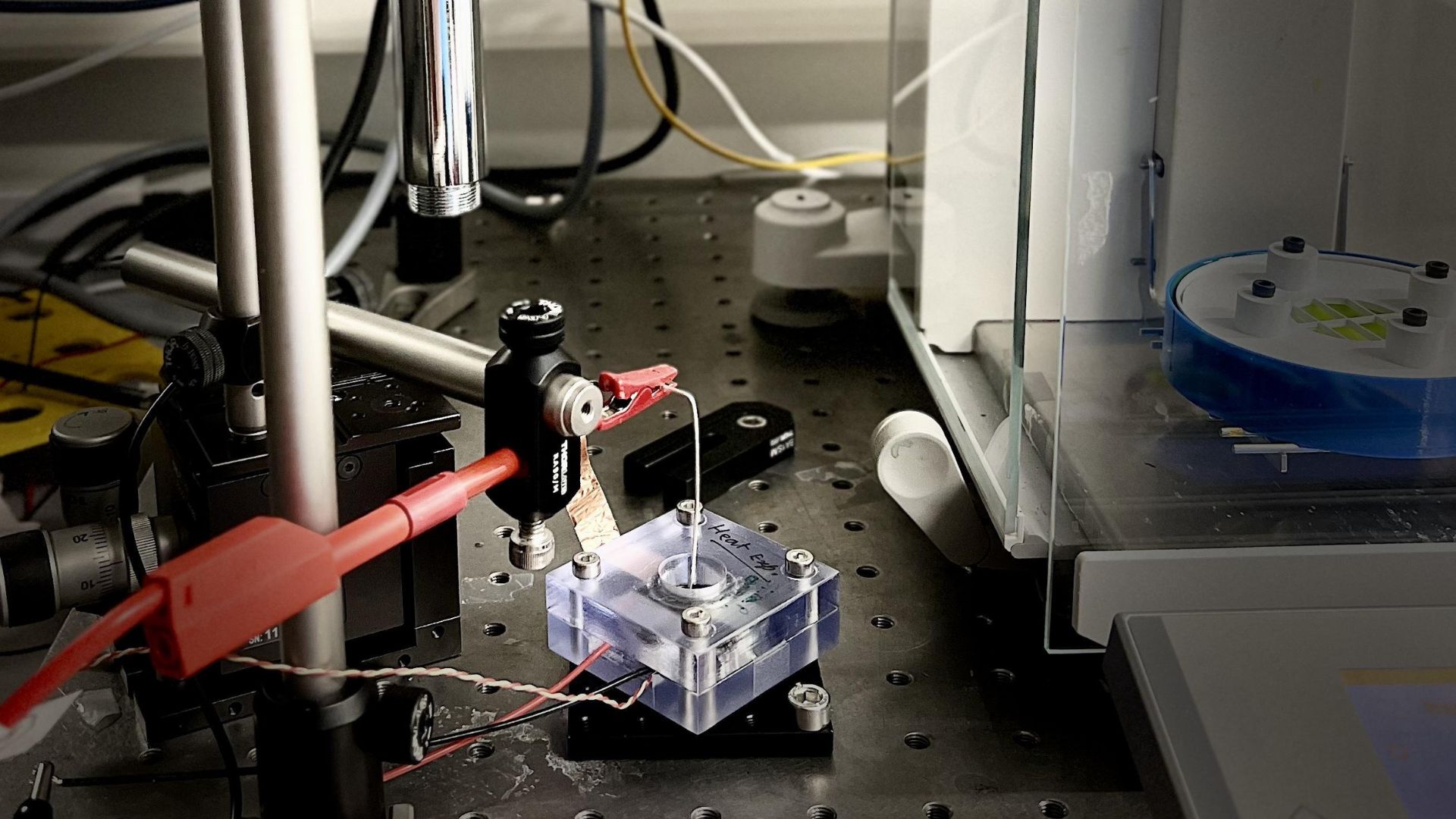
• Swiss nanodevice turns saltwater evaporation into electricity using heat and light The hydrovoltaic device achieves five times higher energy output by controlling ions and electrons. • Researchers at the Laboratory of Nanoscience for Energy Technology (LNET) at the Swiss Federal Institute of Technology Lausanne (EPFL) have engineered a nanodevice that uses light and heat to generate a stable current by evaporating saltwater. • The research is unique because the heat and light are used not only to facilitate evaporation but also to control the flow of ions in saltwater and the flow of electrons in the nanodevice. • Hydrovoltaic (HV) technology is an emerging technology that generates electricity by leveraging the interaction of water with functional materials. • Unlike conventional methods of using water as a fluid to drive turbines, HV effect uses processes such as evaporation or droplet flow to generate continuous electricity. • In 2024, researchers at LNET reported building a nanoscale HV device using silicon nanopillars, in which fluid samples evaporated in the channels created by the spaces between them.
Article Summaries:
- Swiss researchers at EPFL’s Laboratory of Nanoscience for Energy Technology have developed a silicon‑nanopillar hydrovoltaic device that converts saltwater evaporation into electricity with a five‑fold increase in output. By exposing the device to heat and light, the team controls ion migration in the saltwater and electron excitation in the semiconductor, creating a surface charge that drives a stable current. The trilayer design delivers about 1 V and 0.25 W m⁻², and an oxide coating protects the pillars from salt‑induced degradation. The breakthrough could enable battery‑free sensors and wearables powered by water, heat, and sunlight.
Sources: