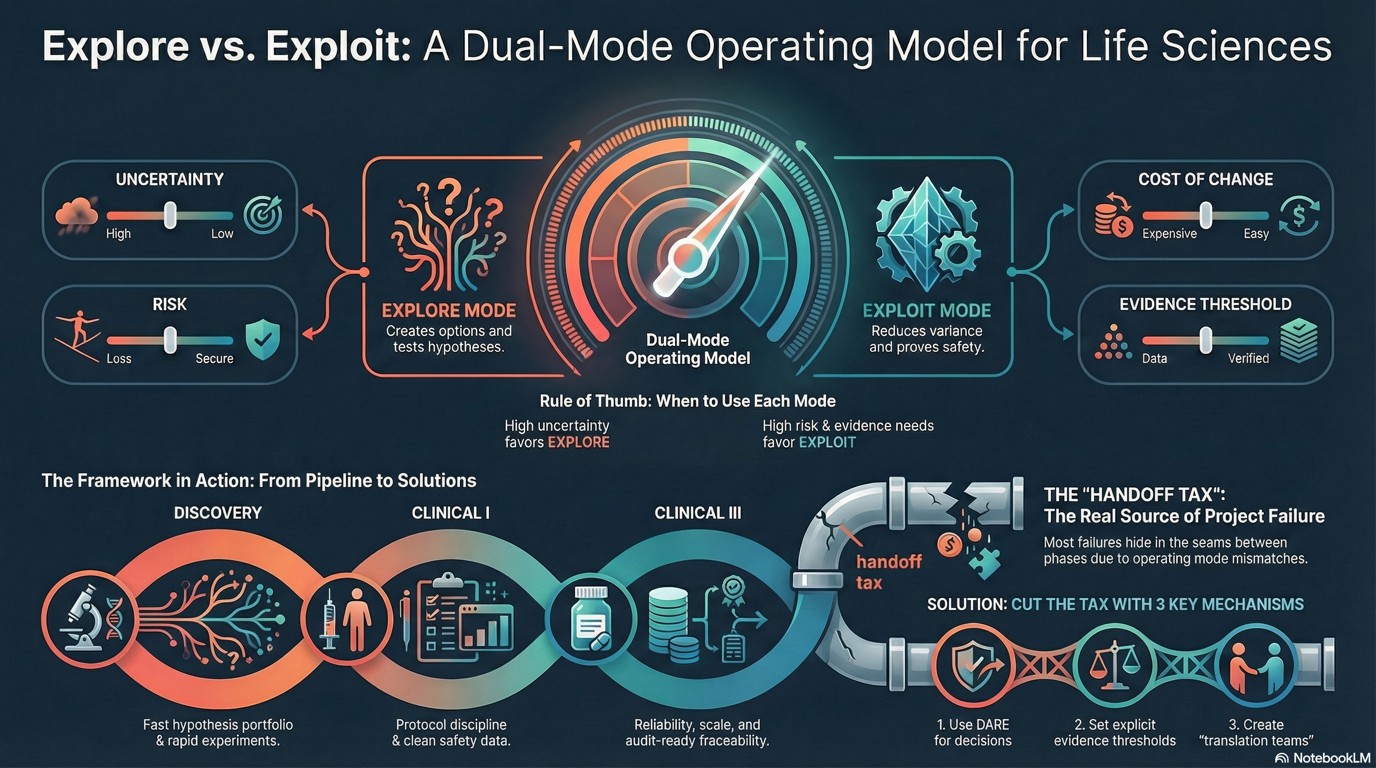
• Stop Picking Sides Manage the Tension Between Adaptation and Optimization Many teams have turned into tribes wedded to exclusively adaptation or optimization. • But this misses the point that both of these are important, and we need to manage the tension between them. • We can do this by thinking of two operating modes: explore (adaptation-dominant) and exploit (optimization dominant). • We tailor a team’s operating model to a particular blend of the two - considering uncertainty, risk, cost of change, and an evidence threshold. • We should be particularly careful at the points where there is a handoff between the two modes 13 January 2026 Contents - Why this matters now (beyond software) - What I mean by “two modes” - A bridge state: “Expand” - The handoff tax - A quick detour: why bimodal IT backfired - A concrete example: Sciex and early integration - Make dominance operational: four dials - Decision rights: use DARE, not RACI - Tailoring: treat it as operating design - The take-away I like Agile. • I like systems that ship and systems that learn.
Article Summaries:
- Summary
A new framework urges teams to balance rapid learning (adaptation) with reliable delivery (optimization) rather than choosing one extreme. The approach defines two operating modes-“Explore” for hypothesis‑driven, low‑cost cycles that reduce uncertainty, and “Exploit” for high‑reliability, evidence‑heavy processes that control risk. It introduces a bridge state called “Expand” to manage handoffs between modes and highlights the “handoff tax” that can erode value. The framework also recommends using DARE (Decision, Accountability, Responsibility, Escalation) over traditional RACI charts and treating the blend of modes as a deliberate operating design. The goal is to enable faster, safer innovation across industries, from software to life sciences.
Sources: