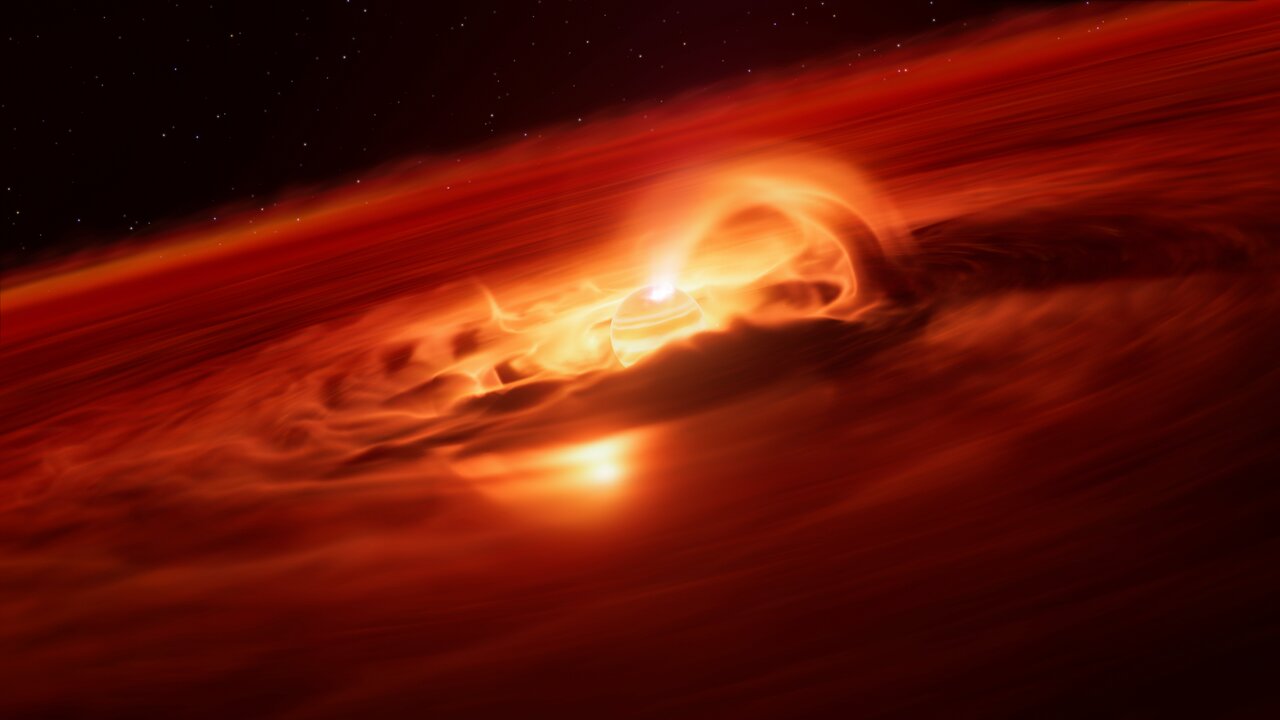
• Press Release Six billion tonnes a second: Rogue planet found growing at record rate 2 October 2025 Astronomers have identified an enormous ‘growth spurt’ in a so-called rogue planet. • Unlike the planets in our Solar System, these objects do not orbit stars, free-floating on their own instead. • The new observations, made with the European Southern Observatory’s Very Large Telescope (ESO’s VLT), reveal that this free-floating planet is eating up gas and dust from its surroundings at a rate of six billion tonnes a second. • This is the strongest growth rate ever recorded for a rogue planet, or a planet of any kind, providing valuable insights into how they form and grow. • “People may think of planets as quiet and stable worlds, but with this discovery we see that planetary-mass objects freely floating in space can be exciting places,” says Víctor Almendros-Abad, an astronomer at the Astronomical Observatory of Palermo, National Institute for Astrophysics (INAF), Italy and lead author of the new study. • The newly studied object, which has a mass five to 10 times the mass of Jupiter, is located about 620 light-years away in the constellation Chamaeleon.
Article Summaries:
- Astronomers have identified a free‑floating planet, Cha 1107‑7626, accreting gas and dust at an unprecedented rate of six billion tonnes per second-an eight‑fold increase over earlier measurements. The planet, 5-10 Jupiter masses and located 620 light‑years away in Chamaeleon, is still forming from a surrounding disc. Observations from ESO’s Very Large Telescope and the James Webb Space Telescope revealed that the accretion burst, the strongest ever recorded for a planetary‑mass object, may be driven by magnetic activity similar to that seen in young stars. The finding suggests that some rogue planets may form like low‑mass stars, blurring the boundary between stars and planets.
Sources: