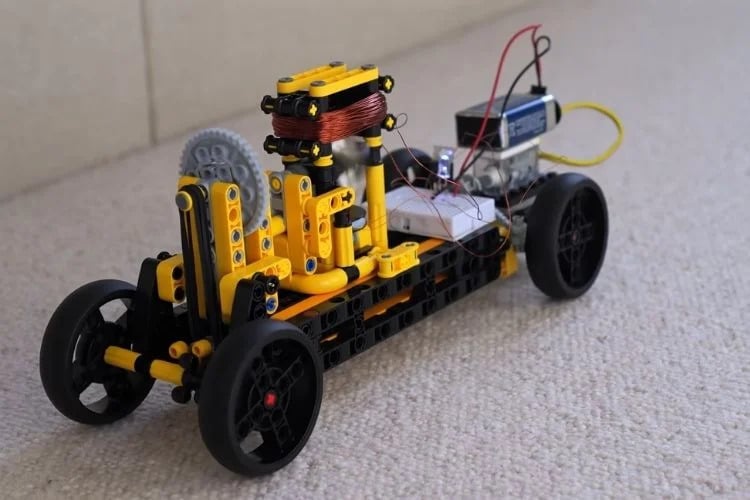
• A maker recently demonstrated how to build a fully functionalself timing electric motorusing only basic electronic components, nomicrocontrollers,motor drivers, or brushes required. • The minimalist design uses a single transistor, two hand-wound coils, a battery, and a pair of neodymium magnets mounted on a rotating shaft. • Instead of relying on electronictiming circuits, the motor uses a clever feedback mechanism where a sensor coil detects the passing magnets and triggers the transistor to energize the main driver coil at precisely the right moment. • As the magnets rotate past the sensor coil, they induce a small voltage that switches the transistor on, sending current through the driver coil. • This creates a magnetic field that repels the rotor magnets, keeping the motor spinning continuously. • An LED connected to the circuit flashes with each pulse, providing a visual indicator of the switching activity.
Article Summaries:
- A maker has showcased a fully functional self‑timing electric motor built with only basic electronic parts-no microcontrollers, drivers, or brushes. The design uses a single transistor, two hand‑wound coils, a battery, and neodymium magnets on a rotating shaft. A sensor coil detects the passing magnets and triggers the transistor to energize the main driver coil at the precise moment, creating a magnetic field that keeps the rotor spinning. An LED flashes with each pulse, indicating the timing. The motor was mounted on a LEGO vehicle via a gear‑and‑belt drive, demonstrating that simple electromagnetic principles can produce efficient, mechanically simple machines.
Sources: